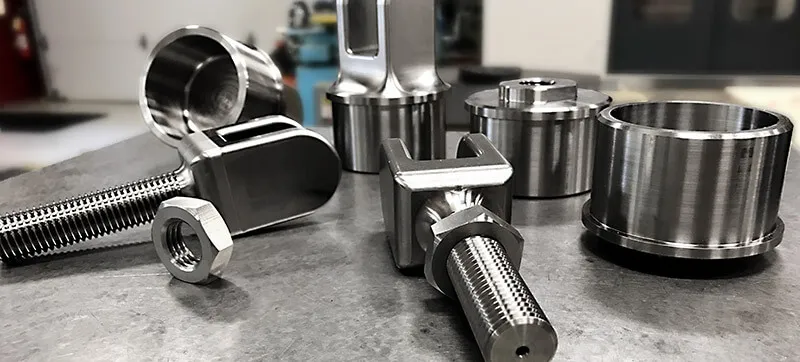
Titanium CNC Machining for Aerospace: Materials, Tolerances, and Why It's Different
Aerospace • Titanium Machining • Precision CNC
Titanium CNC Machining for Aerospace: Materials, Tolerances, and Why It's Different
Titanium is one of the materials that defines modern aerospace. It is also one of the materials that exposes the difference between a general-purpose CNC shop and one built for aerospace work. At Olympus Machining, we routinely produce titanium components for aerospace OEMs, defense contractors, and UAV programs — and the discipline that titanium demands is the same discipline that defines our shop.
Hanover, PA — This post explains where titanium is used in aircraft and spacecraft, why it is harder to machine than aluminum or stainless steel, and what to look for when sourcing CNC-machined titanium parts.
At a Glance
- Grade 5 titanium (Ti-6Al-4V) accounts for over 70% of all titanium alloy used industrially and is the dominant aerospace alloy
- Titanium's low thermal conductivity and chemical reactivity require fundamentally different machining strategies than aluminum or steel
- Aerospace titanium parts routinely require tolerances of ±0.001″ (25 μm) or tighter with full material traceability
- Olympus Machining is ITAR-registered and produces titanium components for aerospace OEMs, defense contractors, and UAV programs
Where Titanium Shows Up in Aerospace
Titanium and its alloys are used across modern aircraft and spacecraft because they combine high strength, low density (about 60% the weight of steel), and exceptional corrosion resistance. They also retain their strength at elevated temperatures — some titanium alloys remain serviceable above 600 °C, which is why they appear deep in the engine section.
Common aerospace applications include:
- Jet engine components — discs, blades, shafts, and casings in compressor sections, where temperatures and stresses make aluminum unworkable
- Airframe structures — wing and fuselage components, joints, and bulkhead fittings where strength-to-weight matters more than absolute mass
- Landing gear — high-strength fittings and structural members that must absorb impact loads
- Fasteners and connectors — high-load fasteners where steel would be too heavy and aluminum would not be strong enough
- Satellite and spacecraft structures — corrosion-resistant, dimensionally stable structural elements
By a wide margin, the workhorse alloy is Grade 5 titanium (Ti-6Al-4V), which accounts for more than 70% of all titanium alloy used industrially. It is fully heat-treatable, holds its mechanical properties up to roughly 400 °C, and carries the strength-to-weight ratio that makes titanium attractive in the first place.
Why Titanium Is Harder to Machine Than Aluminum
Titanium does not behave like aluminum or like the steels most general machine shops are tuned for. Three properties drive the difference:
- Low thermal conductivity. Heat generated at the cutting edge stays at the cutting edge. In aluminum, the chip carries heat away. In titanium, the heat concentrates on the tool, and tool-tip temperatures can climb past 1000 °C in milliseconds at aggressive surface speeds.
- Chemical reactivity at high temperature. Hot titanium will chemically bond with most cutting tool materials, accelerating tool wear and producing built-up edge that ruins surface finish and dimensional accuracy.
- Work-hardening tendency. Titanium hardens under load almost instantly, so dwelling, light cuts, and rubbing the surface make the next pass worse, not better.
The practical consequence is that titanium machining requires a near-inversion of normal logic: slower surface speeds, but aggressive feed per tooth. For Ti-6Al-4V milling with coated carbide, a typical starting window is 25–50 m/min surface speed — five to ten times slower than aluminum — paired with rigid setups, heavy coolant flow directed at the cutting zone, and tooling designed for the alloy.
This is why titanium reveals so much about a shop. A facility that runs aluminum at high SFM and tries to apply the same approach to titanium burns through tooling, produces inconsistent finishes, and misses tolerances. A shop with titanium discipline runs slower, monitors tool wear closely, and treats every cycle as a controlled process.
What "Aerospace Titanium Machining" Actually Requires
Beyond the cutting parameters, aerospace titanium parts come with requirements that follow the part long after it leaves the machine:
- Tight tolerances. Aerospace titanium components routinely call out tolerances of ±0.001″ (25 μm) or tighter, especially on mating surfaces and flight-critical features.
- Material traceability. Every bar of titanium needs to be tied back to its mill certificate, lot, and heat. This is non-negotiable on flight-critical work and is documented as part of our Quality Management System (QMS).
- First Article Inspection (FAI). AS9102-aligned FAI before production release, with full balloon-and-table documentation against the print.
- Process control. Tool-wear tracking, coolant management, and inspection cadence sufficient to catch drift before it becomes a non-conforming part.
- ITAR controls. Titanium aerospace work frequently involves ITAR-controlled technical data, which we handle under documented ITAR-aligned processes.
How Olympus Machining Approaches Titanium
Olympus is a precision CNC milling and turning shop in Hanover, PA. Titanium is a regular part of our workload — engine-adjacent fittings, structural brackets, UAV airframe components, and flight-critical hardware in Ti-6Al-4V and adjacent alloys. Our approach is straightforward:
- Disciplined cutting parameters tuned to the specific alloy and feature, not pulled from a generic feeds-and-speeds chart
- Rigid setups and short tool overhang to keep deflection out of the tolerance budget
- Coolant strategy matched to the operation — flood, through-spindle, or high-pressure as the geometry demands
- First article inspection documented against the print before any production lot ships
- Traceability from mill cert through final inspection
We machine titanium alongside the same range of aerospace alloys — aluminum, stainless steel, Inconel, and engineering plastics — using the same process discipline and quality controls.
Related Capabilities
- CNC Milling Services — 3-, 4-, and 5-axis milling for complex titanium geometries
- CNC Turning Services — Precision turned titanium components
- Quality Assurance — CMM inspection, FAI, and traceability
- ITAR Compliance — Registered and aligned for defense and aerospace work
- Prototype to Production — From first article through production volumes
- Materials We Machine — Full list of alloys and engineering materials
Contact Olympus Machining
Olympus Machining LLC
639 Frederick St, Suite 1
Hanover, PA 17331
Phone: (717) 634-5094
Website: www.olympusmachining.com
Google Business Profile:
View on Google
Request a Quote:
Submit a project
About Olympus Machining
Olympus Machining LLC is a precision CNC machining shop located in Hanover, Pennsylvania. As a dedicated CNC machining shop and reliable machining vendor, we provide CNC milling, CNC turning, and prototype-to-production services for OEMs and manufacturers nationwide.
Related reading: CNC Machining for UAV and Drone Parts: Materials, Tolerances, and Supplier Selection.
Related Articles
Related Capabilities from Olympus Machining
Aerospace & Defense Industry
AS9102-aligned, ITAR-registered aerospace and defense machining.
Titanium CNC Machining
Ti-6Al-4V and other titanium alloys for aerospace structural parts.
AS9102 First Article Inspection
Forms 1, 2, and 3 documentation for aerospace first articles.
Precision CNC Machining
Hanover, PA precision CNC shop for tight-tolerance aerospace parts.
Submit Your Project for Review
Contact Olympus Machining to discuss your CNC machining requirements.