Commercial Airplane Parts CNC Machining: How Precision Machine Shops Build Flight-Critical Components
Commercial Aerospace • CNC Machining • Field Guide
Commercial Airplane Parts CNC Machining: How Precision Machine Shops Build Flight-Critical Components
A practical guide to how commercial airplane parts are CNC machined — covering the categories of parts produced, the alloys involved, the tolerances and certifications required, and how a U.S.-based precision CNC shop in Hanover, Pennsylvania approaches commercial aviation subcontract work.
TL;DR
- A modern commercial airliner contains tens of thousands of machined parts — structural brackets, engine fittings, hydraulic and pneumatic components, landing-gear hardware, and interior structural fittings — and CNC machining produces the majority of them.
- Aluminum 7075-T6 and 6061-T6 dominate airframe brackets; Ti-6Al-4V and Inconel 718 dominate engine and high-temperature hardware; 15-5 PH and 17-4 PH stainless are common in actuators and fittings.
- Tolerances on commercial airplane parts are typically held between ±0.0005″ and ±0.002″, with AS9100 quality systems and AS9102 First Article Inspection driving the documentation chain.
- For Tier 2 and Tier 3 subcontract work, the differentiator is not raw speed — it is repeatability, full material traceability, and the ability to deliver an AS9102 FAIR with the first article and CMM reports with every lot.
Why CNC machining is the dominant process for commercial airplane parts
Commercial aviation parts are defined by three requirements that align almost perfectly with the strengths of multi-axis CNC machining: tight dimensional tolerance, full material traceability, and repeatability across long production runs that may span a decade or more of a given airframe program. Casting, forging, and additive manufacturing each have a role, but for finished structural and mechanical components, subtractive CNC machining remains the dominant production process because it delivers GD&T-controlled features directly from certified mill stock with documented inspection at every step.
A single Boeing 737 or Airbus A320-family aircraft is estimated to contain between 2 and 4 million parts, and a wide-body aircraft can exceed 6 million. Even excluding fasteners, harnesses, and electronics, the machined-part population per airframe is enormous — and every one of those parts is traceable back to a drawing, a heat-lot of material, and an inspection report. That paperwork chain is what separates a commercial aerospace subcontractor from a general-purpose machine shop.
Olympus Machining is a U.S.-based precision CNC machine shop located in Hanover, Pennsylvania that runs aerospace and defense work daily. We are not a Tier 1 airframer; we are a subcontract source for Tier 1 and Tier 2 suppliers that need controlled, repeatable, documented machined parts in low to mid-volume quantities.
Categories of commercial airplane parts produced by CNC machining
Commercial airplane parts that pass through a CNC machining cell typically fall into five broad categories. Each category has its own dominant alloy family, its own typical tolerance band, and its own inspection requirements.
- Airframe structural brackets and fittings. Wing-rib brackets, fuselage frame fittings, floor-beam intercostals, engine-pylon fittings. Predominantly 7075-T6 and 7050-T7451 aluminum plate, machined 3+2 or full 5-axis from solid. Tolerances ±0.001″–±0.005″; profile-of-surface and true-position callouts are the cost drivers.
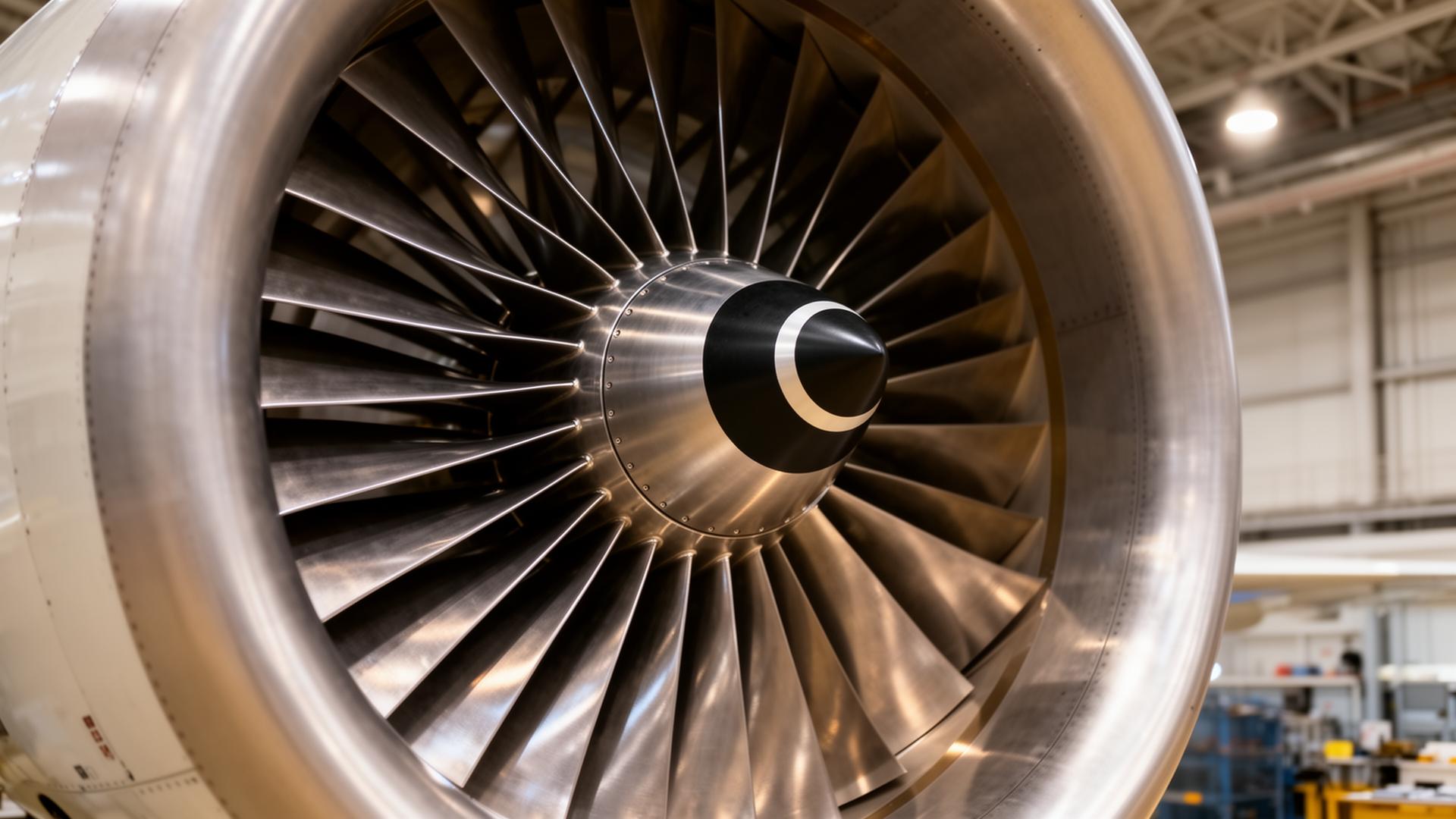
- Engine and nacelle hardware. Fan-case fittings, thrust-reverser actuator brackets, nacelle latch components. Ti-6Al-4V titanium and Inconel 718 dominate. Tolerances tighten to ±0.0005″–±0.002″ with strict surface-finish requirements. Tool wear and work-hardening drive process planning.
- Hydraulic and pneumatic system components. Manifold blocks, valve bodies, actuator end caps, fluid fittings. 15-5 PH and 17-4 PH stainless, 6061-T6 aluminum for low-pressure components. Bore concentricity, port-thread integrity, and surface finish on sealing faces are the inspection focus.
- Landing-gear and high-load components. Forging machining of 300M and 4340 steel landing-gear elements, plus titanium and Inconel high-strength fittings. Large-envelope multi-axis milling and turning, heat-treat process control, and NADCAP-aligned special processes.
- Cabin and interior structural components. Seat-track machining, monument structural fittings, galley and lavatory framework. 6061-T6 aluminum dominates; tolerances are looser (±0.005″–±0.010″) but volume is high and cosmetic surface finish matters.
The alloys behind commercial aviation parts
Material selection on a commercial airplane is engineered for strength-to-weight, fatigue life, and temperature performance — not for ease of machining. A working understanding of each alloy family is part of being a competent aerospace subcontractor.
- Aluminum 7075-T6 and 7050-T7451 — the workhorse airframe alloys. Ultimate tensile strength ~83 ksi (7075-T6), excellent strength-to-weight, machines predictably with sharp carbide and high spindle speeds. Compared at depth in our Aluminum 6061 vs 7075 machining guide.
- Aluminum 6061-T6 — secondary structural, interior, and tooling alloy. Easier to machine than 7075, weldable, anodizes cleanly. Used wherever 7075 is overkill.
- Ti-6Al-4V (Grade 5 titanium) — the dominant titanium alloy in commercial aviation. Engine fittings, landing-gear components, high-temperature brackets. Demands slow speeds, rigid setups, and flood coolant; see our titanium CNC machining capability page.
- Inconel 718 — nickel-chromium superalloy for hot-section engine hardware and exhaust components. Work-hardens aggressively; requires positive-rake ceramic or coated carbide tooling and conservative feeds.
- 15-5 PH and 17-4 PH stainless — precipitation-hardening stainless steels for actuator components and structural fittings requiring corrosion resistance plus high strength after age hardening. For chloride-exposed parts, see our 304 vs 316 stainless comparison.
- 300M and 4340 high-strength steel — landing-gear and high-load forgings. Machined in the soft condition, then heat-treated and finish-ground.
Tolerances, GD&T, and what tight actually means
Commercial airplane part drawings are governed by ASME Y14.5 GD&T. The dimensional callouts that drive cost and process planning are almost never the linear dimensions — they are the geometric callouts: true position of bolt patterns, profile of a surface on machined contours, perpendicularity of bores to mounting faces, and runout on rotating features.
Typical tolerance bands we see on commercial aviation work at our Hanover, PA shop:
- Linear dimensions on machined features: ±0.005″ default, tightening to ±0.001″ on mating surfaces.
- True-position callouts on critical bolt patterns: 0.005″ diameter at MMC.
- Surface finish on sealing faces: 32 Ra microinches; 16 Ra on hydraulic bore IDs.
- Profile-of-surface on aerodynamic or interface features: 0.005″–0.010″ total tolerance zone.
- Bore-to-bore concentricity on actuator housings: 0.0005″–0.001″ TIR.
Holding these tolerances is a function of fixture rigidity, tool selection, thermal management, and disciplined in-process probing — not raw machine accuracy. We cover the underlying practice in detail on our CNC milling services page and our CNC turning services page.
Quality systems: AS9100, AS9102 FAI, and the documentation chain
A commercial airplane part is not finished when it comes off the machine — it is finished when its paperwork is finished. Three documentation pillars drive every commercial aviation subcontract job:
- AS9100 Rev D quality system. The aerospace-specific extension of ISO 9001. Process control, document control, configuration management, and corrective-action discipline are all required.
- AS9102 Rev C First Article Inspection. Every new part number, every design revision, and every significant process change triggers an AS9102 First Article Inspection Report. Forms 1, 2, and 3 must be completed and signed off before the lot is released. We cover this end-to-end on our AS9102 First Article Inspection capability page.
- Material certifications and lot traceability. Every bar, plate, or billet arrives with a certified mill test report tied to a heat or lot number, and that number follows the part through every operation onto the Certificate of Conformance shipped with the lot.
Dimensional inspection on commercial aviation parts is almost always CMM-based for critical features. Olympus runs a Haas HMM 430 CMM with PC-DMIS programming for AS9102 Form 3 characteristic accountability — see the CMM inspection services page for the full inspection workflow. Our broader quality assurance program covers the process controls behind every aerospace lot we ship.
Cybersecurity: FAR 52.204-21 and the Tier 2 supplier baseline
Commercial aviation programs increasingly inherit cybersecurity requirements from their defense and dual-use neighbors. Tier 1 commercial OEMs commonly flow down FAR 52.204-21 Basic Safeguarding (the 17 practices that map to CMMC Level 1) to their subcontractors as a baseline expectation, with NIST SP 800-171 / CMMC Level 2 required when controlled unclassified information (CUI) is present. Olympus is a self-attested CMMC Level 1 shop with SPRS-posted assessment, which satisfies the Basic Safeguarding flow-down and supports both commercial-aviation and dual-use defense programs from a single supplier baseline.
Prototype-to-production: how new commercial parts get qualified
A new commercial airplane part rarely jumps from drawing to a thousand-piece production lot. The qualification path is staged: prototype validation, low-rate initial production, and finally full production. Each stage has its own documentation gate and its own opportunity to surface tooling, fixturing, or programming issues before they turn into a recall.
Our prototype-to-production process is built specifically for this kind of staged qualification — we use the prototype run to lock in the fixture, the program, and the inspection plan, so the AS9102 First Article passes on the first attempt and the production lots that follow are repeatable. The broader context is on our aerospace and defense industry page.
Frequently asked questions
What are the most common commercial airplane parts made by CNC machining?
Structural brackets and fittings (wing ribs, fuselage frames, floor beams), engine and nacelle hardware (fan-case fittings, thrust-reverser actuator brackets), hydraulic and pneumatic components (manifold blocks, valve bodies, actuator end caps), landing-gear components, and cabin structural fittings (seat tracks, monument framework). Aluminum 7075-T6 and 6061-T6, Ti-6Al-4V, Inconel 718, and 15-5 PH / 17-4 PH stainless steels are the dominant alloys.
What tolerances are typical for commercial airplane parts?
Linear dimensions are typically held to ±0.005″ default and ±0.001″ on mating surfaces. True-position callouts on critical bolt patterns are commonly 0.005″ diameter at MMC, bore-to-bore concentricity on actuator housings runs 0.0005″–0.001″ TIR, and surface finish on sealing and hydraulic faces ranges from 16 to 32 Ra microinches.
What certifications does a commercial aerospace CNC shop need?
The baseline is an AS9100 Rev D quality system, AS9102 Rev C First Article Inspection capability, and full material lot traceability. Cybersecurity flow-downs commonly require FAR 52.204-21 Basic Safeguarding (CMMC Level 1) at minimum, with NIST SP 800-171 (CMMC Level 2) where controlled unclassified information is involved. NADCAP accreditation is required for special processes such as heat treat, NDT, and chem-film, but is not required for the CNC machining process itself.
Does Olympus Machining make commercial airplane parts?
Olympus Machining is a U.S.-based precision CNC machine shop in Hanover, Pennsylvania that produces precision machined components for Tier 1 and Tier 2 aerospace and defense suppliers. We are ITAR registered (CAGE 9V9P0) and CMMC Level 1 self-attested, and we deliver AS9102 First Article Inspection reports with the first article on every new part number. For a new commercial-aviation program, send the drawing package and a request for quote and we will return a quoted package with tolerance review, material specification, and lead time.
Ready to quote a commercial aviation program?
Send drawings, material specification, and quantity. We will return a quoted package with AS9102 FAI plan, tolerance review, and lead time.
Explore Olympus Machining's CNC milling, CNC turning, materials capabilities, aerospace and defense industry page, AS9102 First Article Inspection, and prototype-to-production scaling.
Contact Olympus Machining
Olympus Machining LLC
639 Frederick St, Suite 1
Hanover, PA 17331
Phone: 717-601-2362
Website: www.olympusmachining.com
Google Business Profile: View on Google
Request a Quote: Submit a project
About Olympus Machining
Olympus Machining LLC is a precision CNC machining shop located in Hanover, Pennsylvania. As a dedicated CNC machining shop and reliable machining vendor, we provide CNC milling, CNC turning, and prototype-to-production services for OEMs and aerospace manufacturers nationwide. ITAR registered, CMMC Level 1, CAGE 9V9P0.
Related Articles
Related Capabilities from Olympus Machining
Aerospace & Defense Industry
AS9102-aligned, ITAR-registered aerospace and defense machining.
Titanium CNC Machining
Ti-6Al-4V and other titanium alloys for aerospace structural parts.
AS9102 First Article Inspection
Forms 1, 2, and 3 documentation for aerospace first articles.
Precision CNC Machining
Hanover, PA precision CNC shop for tight-tolerance aerospace parts.
Submit Your Project for Review
Contact Olympus Machining to discuss your CNC machining requirements.