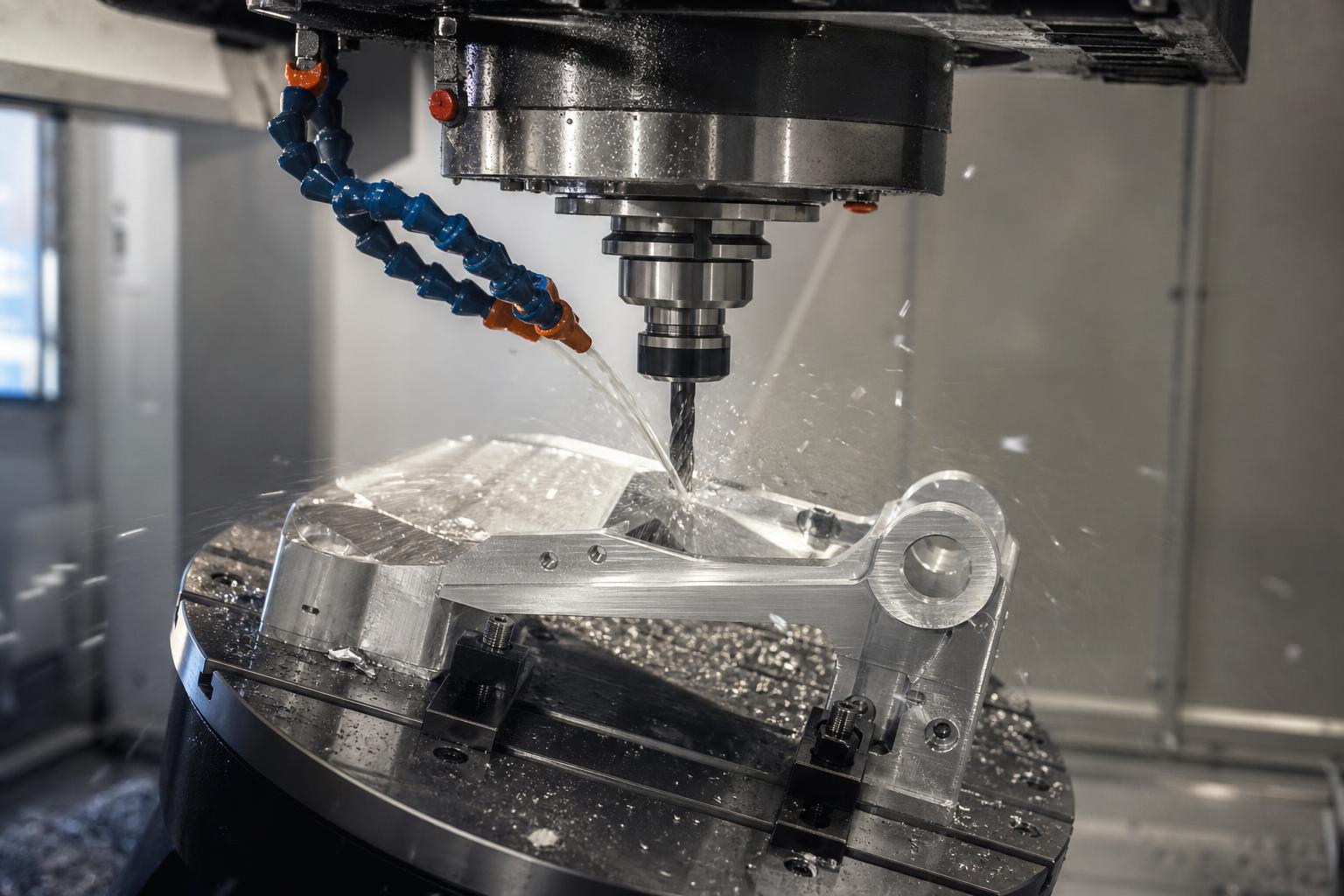
CNC Milling vs. CNC Turning for Metal Prototypes and Aerospace Parts: A Decision Guide
Process Selection • Aerospace • Defense Manufacturing
A working decision framework for engineers choosing between CNC milling and CNC turning on aerospace, defense, and precision industrial parts. Geometry, material, tolerance, and volume considerations from a Hanover, Pennsylvania CNC shop running both processes daily.
TL;DR
- Choose CNC turning when the dominant geometry is rotational — shafts, bushings, fittings, threaded fasteners, hydraulic adapters.
- Choose CNC milling when the dominant geometry is prismatic — brackets, housings, manifolds, structural fittings, plate work.
- Use mill-turn or a turn-then-mill sequence when a part has both rotational and prismatic features — flats on a shaft, cross-holes in a bushing, faceted hydraulic fittings.
- Material rarely decides milling vs turning by itself, but high-temperature alloys (Inconel 718, Ti-6Al-4V) often favor turning for diameters because tool engagement is more predictable.
- For prototypes of 1–10 pieces, setup time and fixturing often decide the process more than the geometry does.
The first cut: geometry
Process selection starts with the part's primary feature axis. If you can describe the part in a single sentence as "a cylinder with…" or "a shaft that…", it is a turning part. If the description starts with "a plate with…" or "a block that…", it is a milling part. Edge cases — and there are many in aerospace and defense work — are handled by mill-turn or by a two-process flow.
A landing-gear bushing with internal grooves and an OD seal land is a turning part. A wing rib with a complex pocket pattern is a milling part. A hydraulic manifold body with a turned ID and milled external flats is a both-process part, and the question becomes which operation owns the critical datums.
Decision matrix
The matrix below is the working guide used at Olympus Machining for quoting aerospace and defense work. It is not a hard rule — there are aerospace shafts with so much cross-feature milling that the part is fixtured on a mill, and there are plate parts with central bosses turned in a sub-spindle.
| Feature pattern | Preferred process | Notes |
|---|---|---|
| Shaft, pin, dowel | Turning | Live tooling for cross-holes and flats. |
| Bushing, sleeve, spacer | Turning | Bore concentricity is best controlled on the lathe. |
| Hydraulic fitting, AN adapter | Turning, then mill flats | Sealing surfaces and threads on the lathe, wrench flats on the mill. |
| Bracket, mounting plate | Milling | Multiple parallel datum planes, drilled and tapped pattern. |
| Housing, manifold body | Milling | Bored ports on a mill or in a sub-op on a lathe. |
| Cylindrical valve body | Mill-turn | Internal bores and external cross-features in one fixturing. |
| Optical mount | Milling | Flatness and parallelism of mounting surfaces dominate. |
| Suppressor baffle stack | Turning | Concentric stack tolerances are a turning strength. |
Tolerance considerations by process
Both processes can hold sub-thousandth tolerances on the right features. The question is which features benefit from which process.
- Concentricity and runout. Always favor turning when concentricity between rotational features matters. A shaft with multiple diameters cut in a single setup on a lathe will hold concentricity that a milled part cannot match.
- Flatness and parallelism on planar surfaces. Milling. Face-milled surfaces with a single fly cutter pass on a stable machine repeat to tenths.
- True position of hole patterns. Milling on a coordinate machine. Position tolerance from a drilled and reamed pattern referenced to milled datums is the standard.
- Thread quality on shafts and bushings. Turning. Single-point threading on a lathe gives better lead accuracy and surface finish than thread milling for OD threads.
- Thread quality in housings and brackets. Milling, using rigid tapping or thread milling. Lower throughput than turning but the geometry forces it.
Material and process interaction
Material rarely overrides geometry, but it shapes the setup.
- Aluminum 6061-T6 and 7075-T6. Both processes are productive. 7075 favors slightly slower feeds and sharper tools to manage stringy chips. Anodized aerospace structural fittings split roughly 60/40 toward milling at Olympus.
- Stainless 303 / 304 / 316. 303 is a free-machining grade and is favored for turned parts where allowed by spec. 316 is required for medical and food-grade work and turns well with appropriate inserts.
- Titanium Ti-6Al-4V. Lower spindle speeds, sharper tools, generous coolant. Turning is often more productive than milling on Ti shafts because tool engagement is constant.
- Inconel 718. Slow, expensive, but routine in defense and aerospace. Ceramic inserts on the lathe for diameters; carbide on the mill for prismatic features.
- 4140 alloy steel. Forgiving on both. Heat-treat-to-finish parts are typically turned-first, milled-second, with hardness verified before grinding.
- PEEK and engineering plastics. Both processes work. Watch for tool deflection on thin-wall turning and for melting at high speeds with insufficient coolant.
Volume, cost, and lead time
For rotational parts, turning is almost always faster per piece than milling. A bushing turned on a bar-fed lathe runs at one piece every 60 to 90 seconds; the same bushing milled from billet runs at one piece every 4 to 6 minutes. For aerospace production lots of 200 to 5,000 units, the process decision can dominate the unit cost.
For prismatic parts, milling is the only practical choice. Five-sided machining on a 4-axis or 5-axis mill consolidates multiple setups into one, reducing both lead time and cumulative tolerance stack.
Prototype and low-volume work follows the same rules but is more sensitive to setup time. A part that could be either process at scale often goes to the machine with the shorter setup for an order of 1 to 10 pieces.
Milling vs Turning for Metal Prototype Parts
The decision matrix above assumes production quantities, where cycle time per piece drives cost. Prototypes break those rules. At a quantity of 1 to 10, setup, programming, and fixturing make up most of the cost of the job. Cutting time is often a small fraction of the total, so the process with the shortest path from model to first chip usually wins, even if it is not the process the part would run on at volume. For broader context on prototype methods, see our rapid prototyping guide.
In practice, for 1 to 10 pieces, setup time and fixturing often decide the process more than the geometry does. A part that is clearly a turning part at 500 pieces may be milled from a billet when only two are needed, because the mill is already set up with a vise and the lathe would need new jaws and a proved-out program.
Prototype decision table
| Feature pattern | Process for 1–10 pcs | Process for 100+ pcs | Why it changes |
|---|---|---|---|
| Short shaft with flats | Turning, then flats on a mill or with live tooling | Turning with live tooling in one setup | At quantity 1–10, a quick second op on a mill vise is cheaper than proving out a live-tool program; at volume, consolidating the flats into the lathe cycle removes a handling step. |
| Bushing | Turning | Bar-fed turning | Rotational in every respect. Turning wins at every quantity; volume only changes how the bar is fed. |
| Small bracket | Milling from plate or billet | Milling, often with dedicated fixtures | The process stays the same. What changes is workholding: a vise and soft jaws for prototypes, a multi-part fixture for production. |
| Round housing with ports | Milling from billet, or turn the body then mill the ports | Turn the body, then mill ports on a fixture (or mill-turn) | For one or two pieces, holding a round blank in a vise and milling everything can beat setting up two machines. At volume, turning the OD and bore is faster and controls concentricity. |
| Plate with a central boss | Milling, including the boss | Milling, with the boss possibly turned in a secondary op | A milled boss is acceptable for prototypes unless the drawing calls tight roundness or runout; at volume, turning the boss can pay off when runout is critical. |
| Threaded fitting | Turning, with wrench flats milled | Turning, with flats milled or cut with live tooling | Sealing faces and threads belong on the lathe at any quantity. The flats move into the lathe cycle once volume justifies the programming time. |
Billet vs bar stock for prototypes
Production turning usually runs from bar stock, and production milling from cut plate or saw-cut blanks. For prototypes, a billet (a block or round slug cut oversize) is often the practical starting point for both. A billet gives the machinist clamping stock to hold onto, room to face and establish datums, and flexibility to move the part between a mill and a lathe.
Machining a turned part on a mill makes sense when the quantity is very small, the round features have generous tolerances, and the part already needs significant milling. The reverse, finishing a mostly prismatic part on a lathe, makes sense when a single bore or boss carries a tight runout or roundness callout that a mill cannot hold as reliably. Either way, the critical features should go to the machine that controls them best, and the rest goes wherever setup is fastest.
Design the prototype so the process carries into production
A prototype that only works with a prototype process creates rework when the program scales. Two habits prevent that:
- Avoid prototype-only features. Do not add clamping tabs, sacrificial bosses, or geometry that exists only because the part was milled from billet, unless they are removed before the part is inspected. If the production part will be turned, design the prototype with features a lathe can produce.
- Lock datums early. Choose datums that suit the production process — typically the OD or a centerline for turned parts and a face for milled parts — and keep them from the first prototype onward. Stable datums let the AS9102 first article inspection carry over instead of being redone when the process changes.
Our prototype-to-production workflow keeps the same setups and inspection approach as volume increases. For the full scale-up picture, see scaling CNC machining from prototype to high-volume production, and for drawing-level guidance, our design for manufacturability guide.
Prototype metals: mill vs lathe behavior
- 6061 / 7075 aluminum. Machines quickly on either process; prototypes are commonly milled from plate or billet even when round. See 6061 vs 7075 aluminum.
- 303 / 304 / 316 stainless. 303 turns cleanly and is a good prototype choice where the spec allows; 304 and 316 work-harden, so steady feeds matter on both machines. See 304 vs 316 stainless steel.
- 17-4 PH stainless. Machines well in the solution or aged condition; plan the heat-treat condition before choosing finish passes on either process.
- Ti-6Al-4V. Constant tool engagement on a lathe makes round titanium features more predictable; milled titanium needs rigid workholding and conservative engagement. See titanium CNC machining.
- Brass. Free-cutting on both processes and especially productive on a lathe; a common choice for fittings and form-and-fit prototypes.
What to send for a prototype quote
- A STEP file and a PDF drawing (see STEP files for CNC machining quotes).
- Material and condition (for example, 6061-T6 or 17-4 PH H1150).
- Critical features and tolerances, with datums identified.
- Quantity now and the expected production quantity, so the process can be chosen with the production route in mind.
With that information, we can recommend CNC milling, CNC turning, or a combined route for the prototype that carries into production.
Mill-turn and combined-process work
Modern aerospace parts increasingly require both processes on the same piece. A turn-mill sequence with the part held in a soft-jaw chuck transferred between machines is standard practice. A true mill-turn machine — a lathe with live tooling and a Y-axis — consolidates the work into a single setup at the cost of higher hourly rate.
The decision is usually driven by datum control. If the critical concentric features need to be coaxial with milled cross-features within a thousandth, the mill-turn approach wins. If the cross-features only need to land within a few thousandths of the centerline, a separate milling op on a fixture is cheaper and equally good.
FAQ
Can a milling machine produce a perfect cylinder?
It can produce a cylinder, but not with the form accuracy of a lathe. Helical milling or contouring on a 3-axis mill leaves a faceted form on close inspection; a turned diameter is true round to the spindle's capability.
When does mill-turn make sense?
When the part has interdependent rotational and prismatic features whose tolerance stack cannot survive a setup change, and when volume justifies the higher machine rate.
Is milling slower than turning?
Per piece on a rotational feature, almost always. Per project on a complex prismatic part, milling is the only realistic option.
How does the choice affect AS9102 inspection?
It does not change what is reported, but it can change the datum strategy. A turned part typically uses the OD or a center as a primary datum; a milled part uses a face. The CMM program follows the print, not the process.
Should I mill or turn a metal prototype?
Start with the critical features: rotational features with tight runout or roundness belong on a lathe, and flat datums and hole patterns belong on a mill. For 1 to 10 pieces, setup time and fixturing often decide the rest, so a mostly round part may be milled from billet when its round features have generous tolerances.
Is CNC turning cheaper than milling for prototypes?
Not automatically. Turning is faster per piece on rotational parts, but at prototype quantities setup and programming dominate cost. If the lathe needs new jaws and a new program while the mill is ready to run, milling can be cheaper for one or two pieces.
Can one prototype be both milled and turned?
Yes. Many prototypes are turned first to establish diameters and bores, then moved to a mill for flats, cross-holes, and ports. The key is to choose datums that both operations can reference, so the same approach and the AS9102 first article inspection carry into production.
Explore Olympus Machining's CNC milling and CNC turning services, our materials capabilities, the aerospace and defense industry we serve, and prototype-to-production scaling.
Contact Olympus Machining
Olympus Machining LLC
639 Frederick St, Suite 1
Hanover, PA 17331
Phone: (717) 634-5094
Website: www.olympusmachining.com
Request a Quote: Submit a project
About Olympus Machining
Olympus Machining LLC is a precision CNC machining shop located in Hanover, Pennsylvania. As a dedicated CNC machining shop and reliable machining vendor, we provide CNC milling, CNC turning, and prototype-to-production services for OEMs and manufacturers nationwide. ITAR registered, CMMC Level 1, CAGE 9V9P0.
Related Articles
Related Capabilities from Olympus Machining
Aerospace & Defense Industry
AS9102-aligned, ITAR-registered aerospace and defense machining.
Titanium CNC Machining
Ti-6Al-4V and other titanium alloys for aerospace structural parts.
AS9102 First Article Inspection
Forms 1, 2, and 3 documentation for aerospace first articles.
Precision CNC Machining
Hanover, PA precision CNC shop for tight-tolerance aerospace parts.
Submit Your Project for Review
Contact Olympus Machining to discuss your CNC machining requirements.