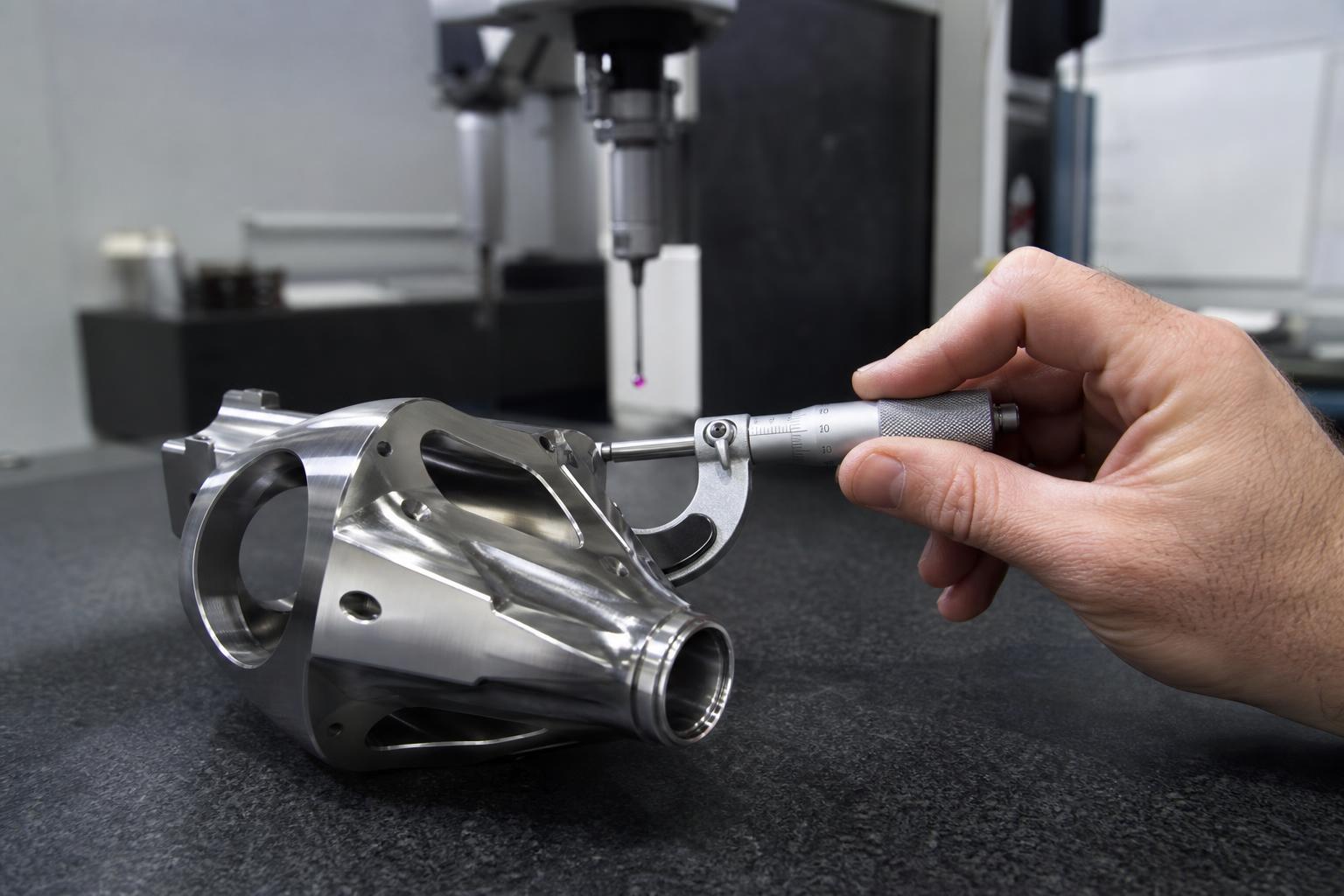
Holding 0.0001" Tolerances in Aerospace CNC Machining: Practical Strategies From the Shop Floor
Precision Machining • Aerospace • Tolerance Engineering
Holding 0.0001" Tolerances in Aerospace CNC Machining: Practical Strategies From the Shop Floor
One ten-thousandth of an inch is small enough to be moved by a draft from an open door. Holding it reliably in production is a function of machine, fixture, probing, and thermal discipline — not heroics. This is how it gets done in a working CNC shop.
TL;DR
- 0.0001" tolerances are achievable in production CNC milling and turning on machines that are not jig grinders, but only when the entire system — machine, fixture, cutter, probe, room — is treated as a thermal and dimensional unit.
- A 1-degree-Fahrenheit shift on a 6-inch aluminum part moves a dimension by approximately 0.00008". On a steel part of the same length, roughly 0.000043". Thermal control is the largest single contributor to tolerance loss at this level.
- In-process probing on the machine is non-negotiable. Post-process CMM verification on a Haas HMM 430 closes the loop and produces the AS9102 evidence the customer expects.
- "Zero tolerance" in shop language usually means sub-0.0005" — true zero tolerance does not exist physically. Honest specs and honest reports build customer trust faster than aspirational ones.
What 0.0001" actually means
One ten-thousandth of an inch is roughly the diameter of a human red blood cell. It is below the resolution of most shop calipers and on the edge of what a quality micrometer can reliably read. At this scale, the work piece, the cutter, the fixture, and the machine spindle are all measurably changing dimension during a single operation as they warm up.
Most aerospace and defense prints calling for tighter than 0.0005" will only have a handful of such features — a critical bore, a sealing surface, a mating face. The strategy is not to hold the whole part to that level. It is to design the process so the critical features are produced under the most controlled conditions the shop can deliver, and to verify them with a measurement system whose uncertainty is roughly 10 percent of the tolerance.
Machine selection and condition
At Olympus Machining the production CNC fleet includes Haas vertical machining centers and turning centers. These are not the most expensive machines available, but production-grade Haas mills with linear-scale feedback, ball-screw thermal compensation, and through-spindle coolant can hold sub-thousandth work reliably when set up correctly. The question is rarely "is the machine capable" and almost always "is the machine ready right now."
- Warm-up cycle. Twenty to forty minutes of spindle and axis cycling before the first tight part of the day. A cold spindle on a Haas VF can drift 0.0003" axially in the first half hour.
- Ball-screw and way condition. Backlash on linear axes should be characterized with a dial indicator and a granite block monthly. Compensation parameters updated, not assumed.
- Spindle runout. Verified with a test bar at the operating spindle speed range. A spindle that runs 0.0002" TIR cold and 0.0001" warm is fine — as long as the operator knows which state the machine is in.
- Tool holder repeatability. Shrink-fit and high-precision ER collets repeat within tenths. Standard end mill holders do not. For 0.0001" work the tooling has to match the spec.
Fixturing for tenths-level work
A part that moves 0.0001" under cutting load can be a part that is in tolerance until the moment a finish pass starts. Fixturing decisions that are invisible at 0.001" become first-order at 0.0001".
- Clamping force placement. Clamps should oppose cutting forces, not work around them. A part held by two jaws and cut on a face perpendicular to the jaw direction can deflect detectably during the cut.
- Stress relief between roughing and finishing. Aluminum extrusions in particular release residual stress when bulk material is removed. A roughing pass, a pause, then a finishing pass holds dimensions that single-pass cutting cannot.
- Hard jaws machined in place. Soft jaws bored on the actual lathe at the actual chuck pressure repeat to tenths. Off-the-shelf jaws do not.
- Coolant placement. Coolant that hits the part on one side only creates a thermal gradient. Through-spindle or fully flooded coolant is preferred for tight work.
Cutting strategy
Finishing strategy at the tenths level is the inverse of roughing strategy. Light depth of cut, climb milling, sharp inserts, and consistent chip load. The cutter should be doing measured work, not surviving abuse.
- Finish depth of cut 0.005" or less, with a spring pass at zero programmed offset to remove tool deflection.
- New or freshly indexed inserts on the finish pass — not a tool that has been roughing for two hours.
- Cutter compensation values verified against a recently qualified tool presetter, not against the last job's offsets.
- Constant surface speed in turning to keep the cutting condition stable across diameters.
In-process probing and post-process CMM
The closed loop for tenths work is on-machine probing for in-process correction, plus post-process CMM for the report of record. At Olympus, on-machine touch probes adjust work offsets between roughing and finishing, and the Haas HMM 430 CMM in the metrology area produces the AS9102 Form 3 evidence.
The 10:1 rule applies: the measurement system uncertainty should be no more than 10 percent of the tolerance. For a 0.0001" tolerance that means a measurement uncertainty under 0.00001", which is at the edge of what shop CMMs in a temperature-controlled room can deliver. Realistically, parts at this level are inspected against a master, with the CMM characterizing the difference between the part and a calibrated reference.
Material behavior at tenths
Material choice changes the strategy more than people expect.
- Aluminum 6061-T6 and 7075-T6. Thermally lively — coefficient of expansion around 13 × 10⁻⁶ per degree Fahrenheit. Holds form well once stabilized but moves during cutting.
- Stainless 303 and 316. Lower expansion, but work-hardens under poor cutting conditions. Finishing in a single pass with a sharp tool is preferred.
- Titanium 6Al-4V. Low thermal conductivity concentrates heat at the cutting edge. Tool life is the limiting factor; finishing offsets need to be checked more frequently.
- Inconel 718. Possible but slow. Tight tolerances on Inconel are normally produced in a separate finishing operation on a fresh setup.
- PEEK and engineering plastics. Thermal expansion is an order of magnitude higher than metal. 0.0001" tolerances on PEEK are not realistically achievable without environmental control beyond a normal shop.
Honest spec discussion
The shop floor is the wrong place to negotiate a print. The right place is the DFM conversation before the work is quoted. When a customer drawing calls for 0.0001" on a feature that does not need it, the right answer is to ask why — because the tooling, fixturing, inspection, and yield consequences of that callout are large, and a 0.0005" tolerance often serves the design intent with no functional loss.
When the tolerance is genuinely needed — a hydraulic sealing surface, a press-fit bushing bore, a precision optic mount — the shop should be confident in committing to it, and equally clear about what the part costs and what the inspection package will look like.
FAQ
Can a Haas VF mill really hold 0.0001" tolerances?
On specific features under controlled conditions, yes. Across an entire part envelope, no — and no production machining center can. Tenths-level work is feature-level, not part-level.
Is "zero-tolerance machining" real?
No. It is shop shorthand for sub-thousandth or sub-half-thousandth work. Anyone advertising literal zero tolerance is using the phrase loosely.
What inspection equipment is required?
A CMM with the appropriate measurement uncertainty, a calibrated master where applicable, micrometers with 0.00005" resolution, and a temperature-controlled inspection area. All gages on a calibration recall schedule with traceable certificates.
How does the room temperature affect a part?
For a 6-inch aluminum part, every 1°F change shifts the dimension by approximately 0.00008". A part inspected at 70°F and put into a 72°F assembly is dimensionally different when it gets there.
Related capabilities: precision CNC machining, CNC milling, CNC turning, CMM inspection, and quality assurance.
Contact Olympus Machining
Olympus Machining LLC
639 Frederick St, Suite 1
Hanover, PA 17331
Phone: (717) 634-5094
Website: www.olympusmachining.com
Request a Quote: Submit a project
About Olympus Machining
Olympus Machining LLC is a precision CNC machining shop located in Hanover, Pennsylvania. As a dedicated CNC machining shop and reliable machining vendor, we provide CNC milling, CNC turning, and prototype-to-production services for OEMs and manufacturers nationwide. ITAR registered, CMMC Level 1, CAGE 9V9P0.
Related Articles
Related Capabilities from Olympus Machining
Aerospace & Defense Industry
AS9102-aligned, ITAR-registered aerospace and defense machining.
Titanium CNC Machining
Ti-6Al-4V and other titanium alloys for aerospace structural parts.
AS9102 First Article Inspection
Forms 1, 2, and 3 documentation for aerospace first articles.
Precision CNC Machining
Hanover, PA precision CNC shop for tight-tolerance aerospace parts.
Submit Your Project for Review
Contact Olympus Machining to discuss your CNC machining requirements.