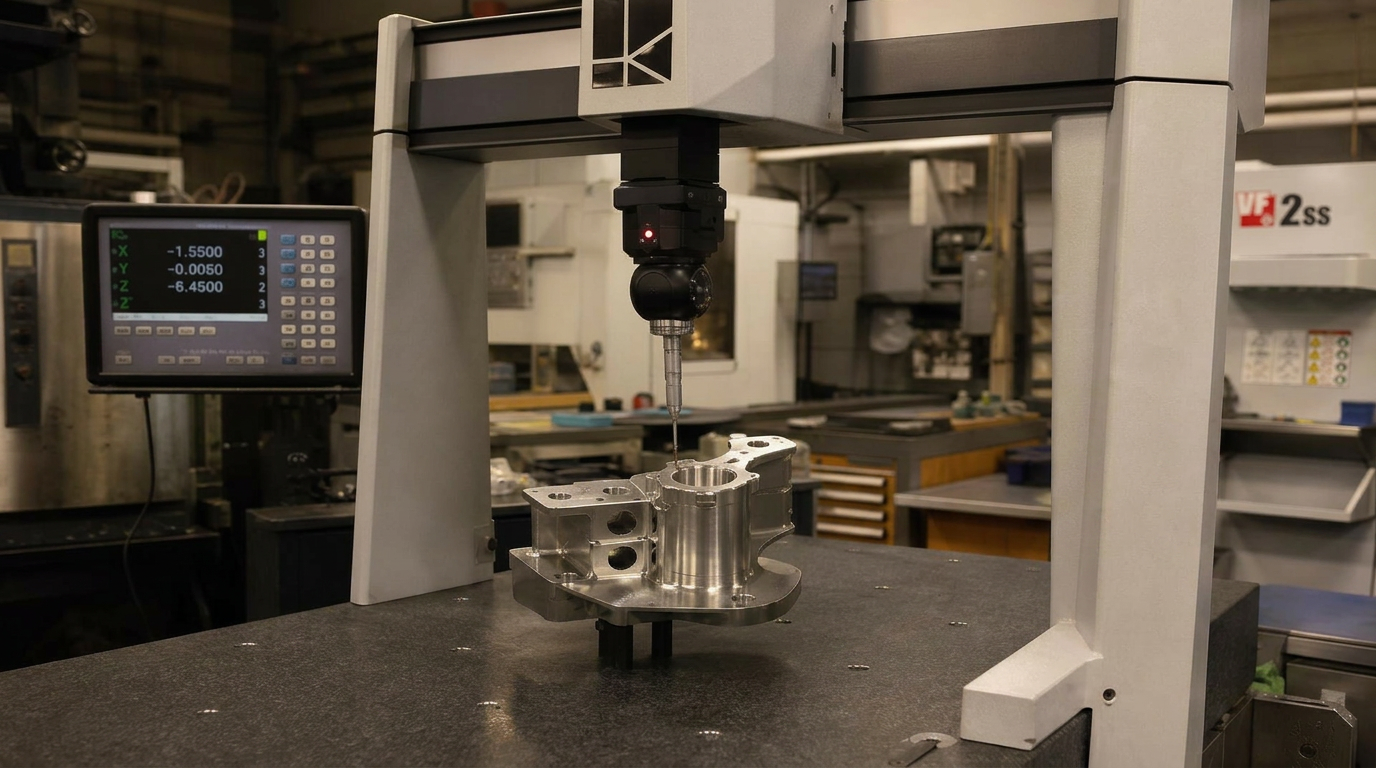
Achieving Sub-Mil Tolerances: Advanced Machining Strategies for 0.0005 Inch Accuracy
Precision Machining • Sub-Mil Tolerances • GD&T & Metrology
Achieving Sub-Mil Tolerances: Advanced Machining Strategies for 0.0005 Inch Accuracy
A working playbook from a U.S.-based precision CNC shop in Hanover, Pennsylvania — how machine geometry, thermal control, workholding, tooling, and metrology come together to hold half a thousandth of an inch repeatably in production.
TL;DR
- A 0.0005" tolerance (12.7 µm) cannot be hit by toolpath alone — it requires a controlled system across machine, thermal, workholding, tooling, material, and metrology.
- Form tolerances (roundness, flatness, concentricity, position) are usually tighter than size tolerance and are the real failure mode in production.
- Holding 0.0005" in production means rough → semi-finish → finish stock allowances, constant tool engagement, spring passes, and in-process probing with automatic offset compensation.
- Bores hit 0.0005" with reaming or honing; flats below 0.0003" need grinding or lapping; hardened features need ID/OD grinding.
- Measurement system must consume ≤10% of tolerance (Gage R&R), inspection room held at 20 °C ±2 °C, parts soaked 2–4 hours before measurement.
Understanding 0.0005 Inch Tolerance: What It Means and Why It Matters
A 0.0005 inch tolerance—or half a thousandth of an inch (12.7 micrometers)—sits at the boundary between conventional precision machining and true ultra-precision work. It is small enough to be invisible to the human eye, yet large enough to be achievable with disciplined CNC machining when the entire process is aligned around it.
In aerospace bearing races, medical implant journals, and defense hydraulic components, 0.0005 inch tolerances are often non-negotiable. They appear not because engineers love tight specs, but because the application demands it: a 0.0005 inch variation in a bearing bore can shift preload by microns, degrade load distribution, or cause premature wear. In a fuel injector nozzle, it controls spray cone angle. In a missile guidance system, it affects vibration modes.
The challenge is that 0.0005 inch is tight enough that it cannot be achieved by toolpath alone. It requires a system: the right machine geometry, thermal control, workholding discipline, material stability, tooling precision, and metrology that accounts for measurement uncertainty. A single variable—thermal drift, tool wear, or improper datum control—will break the tolerance.
GD&T Implications for Sub-Mil Accuracy
Geometric dimensioning and tolerancing (GD&T) language becomes critical at 0.0005 inch. A bare nominal size is insufficient; the drawing must specify how the tolerance is distributed and what it controls.
Size tolerance alone (e.g., 0.500 ± 0.0005 inch) controls the two-point envelope of a feature but does not guarantee form or orientation. A bore nominally 0.500 inch can be 0.0005 inch oversize on one side and undersize on the other and still fall within the bilateral tolerance band—yet be wildly out of round.
At 0.0005 inch, form tolerances become equally critical:
- Roundness (circularity) limits how much a circular feature can deviate from a perfect circle. For a bore or turned journal, roundness tolerance is often 0.0002 to 0.0004 inch—tighter than size—to ensure proper fit and load distribution.
- Straightness controls linear elements of a feature, essential for shafts and guideways.
- Concentricity ensures that internal and external features share a common axis, crucial for bearing bores and rotating assemblies.
- Flatness and parallelism govern milled faces and datums, preventing angular distortions that ripple through positional stacks.
- Position (true position) defines a feature location relative to datums. At 0.0005 inch bilateral position tolerance, the feature center can drift only ±0.00025 inch from its true location—a tolerance zone of 0.0005 inch diameter, roughly the width of a human hair.
Each GD&T call-out reflects a functional requirement. Ignoring the difference between size and form tolerance, or failing to establish robust datums, is a frequent root cause of tolerance failures in production.
Feature-Specific Demands: Size, Form, Orientation, and Location
The practical demands of 0.0005 inch vary by feature type:
Internal Diameters (Bores) A 0.0005 inch bore size tolerance demands stock control within ±0.00025 inch at the finish diameter. Roundness (form) tolerance is typically 0.0002 to 0.00025 inch. The bore must be circular to within 0.0002 inch TIR (total indicated runout) and coaxial with a datum axis to within similar limits. Honing or precision reaming is the typical finishing process; boring alone often cannot achieve the roundness control needed.
External Diameters (Turned Journals) Achieving 0.0005 inch size and roundness on a turned diameter requires tool geometry that minimizes deflection, constant tool engagement to avoid chatter, and often a spring pass or dwell time. Concentricity—the coaxial alignment of the journal to the part's rotating axis—becomes a separate GD&T callout, typically 0.0002 to 0.0003 inch.
Milled Faces (Flatness and Parallelism) Flatness at 0.0005 inch over a large face (e.g., a 2 × 3 inch mounting pad) is challenging; the face must deviate no more than 0.0005 inch from a perfect plane across the entire area. Parallelism to a datum face often calls for tighter control than size. Large flat faces frequently require a secondary grinding or lapping pass after milling.
Positional Tolerances A hole or pocket positioned to 0.0005 inch true position (bilateral) requires stable datum references. The datum planes or axes must be machined first and held to sub-mil form and parallelism, then used as the reference frame for positioning. Datum establishment is often the limiting factor.
Foundational Elements for Sub-Mil Machining Success
Holding 0.0005 inch in production is a systems problem. Five foundational variables govern whether it is achievable:
Machine Tool Capability and Volumetric Accuracy
A CNC milling or turning center's intrinsic precision sets the baseline. No amount of clever programming or tooling discipline can overcome a machine with 0.0010 inch of spindle runout or 0.002 inch of table straightness error.
Key machine specifications for 0.0005 inch work:
- Spindle runout (TIR): Less than 0.0001 inch is ideal; 0.00015 inch is acceptable. Runout above 0.0002 inch creates chatter and size variation.
- Volumetric accuracy: The machine's ability to position the tool relative to the workpiece across all axes. Modern high-precision machines exhibit ±0.0002 inch per 12 inches of travel or better.
- Geometric accuracy: Parallelism of the table to the spindle, perpendicularity of axes, and squareness of travel planes.
- Thermal stability: The machine frame's expansion and contraction over a day. A machine that drifts 0.0003 inch during warm-up will not hold 0.0005 inch early in a production run.
Machines rated for 0.0005 inch work—such as high-precision VMCs (vertical machining centers) or CNC turning centers with live tooling—are typically reconditioned or newer models with tight specifications and rigorous acceptance testing.
Thermal Management: The Silent Tolerance Killer
Temperature change is the primary source of dimensional drift in sub-mil machining. A 10°F rise in coolant temperature can expand a steel spindle by 0.0002 to 0.0003 inch. A part machined at 7 a.m. (cool machine, cool coolant) will be smaller than the same part machined at 2 p.m. (warmed spindle and table).
Thermal control strategies:
-
Machine warm-up: Run the machine under cutting load for 20–30 minutes before starting production. Execute a practice part or scrap. Allow spindle and ballscrews to reach thermal equilibrium with the cutting environment.
-
Coolant temperature: Maintain coolant within ±1°F using a chiller. A 50-gallon coolant sump with active chilling is standard for 0.0005 inch work. Coolant temperature directly affects spindle thermal growth and tool life.
-
Part temperature: Long, light finishing passes generate low cutting forces but also low heat; the part remains thermally stable. Heavy finishing passes generate heat that expands the part during machining, causing over-size parts. Minimize cutting forces through constant tool engagement and avoid plunging or interrupted cuts.
-
Environmental control: The machine room should be maintained at 68–72°F, ±2°F. Wide room temperature swings cause machine frame expansion and contraction, creeping thermal errors into the tolerance band.
-
Tool thermal growth: A carbide drill bit expands measurably under cutting loads. For 0.0005 inch bores, thermal compensation algorithms adjust tool offsets in real time based on cutting time and tool temperature estimates.
Workholding Rigidity and Datum Control
A part that flexes under cutting force will not hold 0.0005 inch. Workholding must be rigid, repeatable, and stable throughout the cycle.
Datum control: The part drawing establishes primary, secondary, and tertiary datums—typically three planes that define the part's orientation in space and form the baseline for all GD&T callouts. Workholding must align the actual part features (not the nominal geometry) to these datums.
- Primary datum: Often a large, flat face. It must be machined first to high flatness (0.0002 to 0.0003 inch) and then used as the clamping reference throughout the job.
- Secondary datum: Usually perpendicular to primary, established after primary datum is complete.
- Tertiary datum: The third plane, completing 3-2-1 datum locating.
If workholding does not respect datum hierarchy, positional tolerances will fail. A bore that is nominally true-to-position on the drawing can be 0.0010 inch off-location in the machine if the part shifts or the datum face is not square to the spindle axis.
Workholding specifics:
- Clamping force: Sufficient to prevent part movement (typically 500–2000 lbf depending on cutting forces and feature geometry) but not so high as to distort the part. Hydraulic vises with pressure regulators are standard.
- Contact surfaces: Smooth, parallel, and free of burrs. Burrs under a clamped edge allow micro-movement.
- Repeatability: Soft jaws custom-ground for the part geometry ensure that the part seats identically on each setup. Hard jaws with custom inserts are preferred for production runs.
- Part support: Avoid cantilevered geometry. Back-support thin walls or use steady rests on turning centers to minimize deflection.
Tooling Selection and Management
Tool geometry, material, and runout have outsized influence on sub-mil accuracy.
Toolholder and spindle interface:
- Runout (TIR): The tool holder and tool assembly must have less than 0.0001 inch of runout at the cutting edge. This is verified using a precision spindle taper gauge and dial indicator before each job.
- Toolholder balance: Out-of-balance toolholders cause vibration, chatter, and tool deflection. Dynamic balancing of tool-holder-tool assemblies to ISO Grade 2.5 or better reduces vibration to sub-micron levels.
Tool geometry and material:
- Carbide vs. HSS: Carbide tools hold geometry and resist thermal drift far better than high-speed steel. For 0.0005 inch finishing, carbide is non-negotiable.
- Coatings: PVD coatings (TiN, AlTiN, CrN) improve wear resistance and reduce friction, minimizing thermal input and extending tool life. For finishing, a fine-grained uncoated or lightly coated insert is often preferred over heavily coated tools, which can have edge buildup.
- Nose radius and edge prep: A sharp, well-honed edge (micro-edge) produces better surface finish and size control than a rounded nose. Custom edge honing of inserts (0.00005 to 0.0001 inch micro-edge) is common for finishing.
- Deflection management: Tools must be short and rigid. Tool overhang (the distance from the tool holder to the cutting edge) should be minimized; for boring bars, overhang should be 2 to 3 times the bar diameter at most.
Tool life and offset management: Tool wear is inevitable and continuous. As a tool wears, the cutting edge recedes by 0.00005 to 0.0001 inch per minute of cutting (depending on material and speed). For a 2-hour production run, cumulative wear can exceed 0.0005 inch.
- Offset compensation: Modern CNC controllers allow tool wear offsets. Offsets are adjusted every 10 to 30 parts (or every 1 to 5 minutes of cutting) based on in-process probing or periodic measurement. The machine automatically moves the tool path outward (for external features) or inward (for bores) to compensate for wear.
- Tool life limits: A tool is retired long before catastrophic failure. At 0.0005 inch tolerance, tools are often changed after 50–200 parts, even if they appear to have useful life remaining.
Material Considerations: Stability and Stress Relief
The material itself affects achievable tolerance.
Material condition:
- Stress relief: Parts in non-heat-treated aluminum or annealed stainless steel can exhibit stress relaxation during or after machining. A part that is 0.0003 inch smaller after machining may grow 0.0001 inch over the next 24 hours as internal stresses relax.
- Heat treatment: Steel or titanium parts that undergo heat treatment after rough machining are susceptible to distortion. Finish machining should occur after final heat treat, but if it must occur before, the part should be aged or stress-relieved at 300–500°F to stabilize dimensions before finish cutting.
- Material hardness: Work-hardened aluminum or stainless can exhibit built-up edge (BUE) formation during machining, causing size and finish variation. Annealed or solution-heat-treated material machines more predictably.
Machinability factors:
- Chip formation: Free-machining materials (like 12L14 steel or brass) produce small, curly chips that do not dig back into the finished surface, improving surface finish and dimensional accuracy.
- Thermal growth: Materials with high thermal conductivity (aluminum, copper) conduct heat away from the cutting zone, reducing tool wear and part thermal growth. Poor conductors (stainless, titanium) trap heat, leading to faster tool wear and part growth during machining.
Precision Machining Strategies for 0.0005 Inch Accuracy
With foundational elements in place, specific machining techniques deliver repeatable sub-mil results.
Multi-Stage Stock Removal and Toolpath Optimization
Holding 0.0005 inch tolerance requires a disciplined stock removal strategy that minimizes force, heat, and tool deflection.
Stock allowance planning:
- Roughing allowance: Leave 0.010 to 0.020 inch stock for semi-finishing and finishing passes. This allows rough tooling with higher feeds and speeds.
- Semi-finish allowance: After roughing, leave 0.003 to 0.005 inch for finishing. This pass removes most of the roughing chatter and dimensional inaccuracy, preparing the geometry for fine finishing.
- Finish allowance: The final pass removes 0.0005 to 0.002 inch. This is a light, constant-engagement pass with conservative speeds and feeds that minimize cutting forces and thermal input.
Constant tool engagement: Avoid interrupted cuts, plunging, or rapid spindle acceleration during finishing. Constant tool engagement means the cutting edge is always in contact with material, preventing chatter and micro-impacts that cause size jumps and roundness errors. For bores, use a straight feed without peck drilling or intermittent cuts.
Feed rate strategy: Finishing feeds should be conservative—0.001 to 0.003 inch per tooth (per revolution for turning)—to minimize cutting forces and heat. High feeds accelerate tool wear and cause thermal growth; low feeds prevent chatter and allow precise size control. The optimal feed is the lowest rate that avoids chatter and keeps spindle load steady.
Spindle speed: Speeds must be tuned to material, tool size, and cutting edge sharpness. For a 0.375 inch carbide end mill in aluminum, typical finishing speed is 1000–1500 RPM (surface speed of 400–600 SFM). For tight tolerance boring, speed may be 500–1000 RPM to minimize thermal input and tool deflection.
Advanced Techniques for Feature Finishing
Sub-mil finishing demands techniques beyond standard milling or turning:
Spring passes and dwell: After the main finishing pass, a spring pass—a second, very light pass over the same geometry with zero or minimal feed—can reduce surface finish and improve roundness. Tool deflection during the spring pass is minimal, and the edge just "scrapes" the surface, producing superior geometry. A dwell—holding the tool at a fixed location—allows cooling and relieves residual stress in the just-machined material.
Boring head techniques for precision bores:
- Boring with spring compensation: Adjustable boring bars with spring-loaded cutting edges automatically compensate for tool deflection, maintaining a constant distance from the bore wall. These bars are essential for 0.0005 inch bore accuracy.
- Fine-feed boring: After the main boring pass, execute a final boring pass with spindle speed reduced by 30–50% and feed reduced to 0.0005 to 0.001 inch per revolution. The lower speed and feed minimize cutting force and thermal distortion.
Turning strategies for concentricity: On a CNC turning center, concentricity (coaxial alignment of a diameter to the part's spindle axis) is controlled by tool path and spindle stability.
- Continuous cutting (no interruption): Machine the entire feature in one pass to avoid spindle runout caused by retraction and re-engagement.
- Tool geometry: A round-nosed insert (0.031 to 0.062 inch nose radius) and approach angle of 5–15 degrees produces better concentricity than sharp-cornered tools.
- Spindle warm-up: Spindle thermal growth affects concentricity. Allow spindle to stabilize before machining the concentric feature.
In-Process Verification and Adaptive Control
Modern precision CNC machines integrate in-process probing to measure features and adjust tool offsets in real time.
Probing workflow:
- After finishing the first feature (e.g., a bore), the machine automatically measures it using a precision probe inside the spindle.
- The measured dimension is compared to the target nominal size.
- If the feature is 0.00015 inch undersize, the controller automatically adjusts the tool offset outward by 0.00015 inch.
- The next part is machined with the adjusted offset, reducing size error.
Wear compensation: Tool wear is predictable. If a tool wears 0.0001 inch per 10 parts, the controller can automatically apply increasing offset corrections across a production run, keeping all parts within tolerance band.
Adaptive feed rate reduction: If spindle load (a proxy for cutting force) exceeds a threshold during finishing, the controller automatically reduces feed rate, preventing chatter and excessive deflection.
Feature-Specific Playbooks for 0.0005 Inch Tolerances
Achieving 0.0005 inch is feature-dependent. Here are the most common scenarios:
Precision Bores: Reaming, Boring, and Honing Strategies
When to use each finishing method:
| Method | Bore Range | Roundness | Surface Finish | Cost/Time | Best For |
|---|---|---|---|---|---|
| Reaming | 0.125–2.0" | ±0.0001–0.0003" | 16–32 µin | Fast, low cost | Tight roundness, no honing |
| Boring | 0.25–6.0" | ±0.0002–0.0005" | 32–64 µin | Flexible, medium | Large bores, form control |
| Honing | 0.5–6.0" | ±0.00005–0.0002" | 4–16 µin | Slow, high cost | Best roundness & finish |
| Grinding (ID) | 0.1–4.0" | ±0.00005–0.0001" | 8–16 µin | Slow, high cost | Hardened features, ultra-tight |
Reaming for 0.0005 inch size: A precision reamer (0.0005 to 0.001 inch RH tolerance) creates a ±0.0002 to ±0.0005 inch bore size when fed at 0.002–0.005 inch per revolution into a pre-drilled hole. Roundness is typically 0.0001–0.0003 inch, better than boring alone. Reamers are fast and repeatable; a 0.500 inch bore can be finish-reamed in under 30 seconds.
Limitations: Roundness degrades if reamer deflects (long, thin shank). Reamers are single-use and cannot adjust if bore is oversize; a worn or damaged reamer produces oversize holes.
Boring for form control: Precision boring with a spring-compensated boring bar and light feed (0.001 inch per revolution) produces ±0.0002 inch roundness and size control. The advantage is flexibility: if the bore is slightly oversize, the tool offset is adjusted for the next part. Multiple diameters can be bored in sequence.
Example process for a 0.5000 ± 0.0005 inch bore with roundness ≤ 0.0002 inch:
- Rough drill (0.4375 inch) to 0.020 inch oversize.
- Semi-finish bore at 800 RPM, feed 0.003 ipr, leaving 0.005 inch stock.
- Finish bore at 400 RPM, feed 0.001 ipr, reducing spindle speed to minimize thermal growth.
- In-process probe the bore after finishing.
- Adjust tool offset if needed and bore the next part.
Honing for ultimate roundness: Honing (using abrasive stones in a rotating mandrel) produces roundness to ±0.00005–0.0001 inch and surface finish to 4–16 µin. The process is slow (a 0.5 inch bore requires 2–5 minutes of honing) and adds cost, but is indispensable when drawing specifies roundness tighter than 0.0001 inch.
Honing process:
- Bore is finish-machined to 0.0005–0.001 inch undersize (e.g., 0.4990 inch for a 0.5000 inch target).
- Hone mandrel (with abrasive stones sized for the bore) is inserted and rotated at 200–600 RPM.
- Mandrel expands slowly, and abrasive stones float radially, self-correcting for bore taper.
- Final bore is measured with air gage; honing is stopped when bore reaches target ±0.0001 inch.
Verification: Air gages for 0.0005 inch bores: An air gage (also called pneumatic gage) measures bore diameter by flowing compressed air through precision orifices. Air gages are non-contact and repeatable to ±0.00005 inch—better than CMM probes for bores. They read instantaneously and require no thermal stabilization.
Master rings (precision reference bores, traceable to NIST) are used to calibrate air gages. A set of master rings in 0.0001 inch increments (e.g., 0.4998, 0.4999, 0.5000, 0.5001, 0.5002) allows the operator to bracket the bore size and adjust offsets.
Achieving Accuracy on Turned Diameters
External diameters on a CNC turning center must control both size and concentricity—the coaxial alignment to the spindle axis.
Size control:
- Rough turn to 0.020 inch oversize.
- Semi-finish turn, leaving 0.003–0.005 inch stock.
- Finish turn at reduced speed (spindle warm, thermal growth stabilized) with feed 0.001–0.002 ipr and minimal pressure.
- In-process probe the diameter using a probe in the spindle or a traveling probe; adjust tool offset for the next part.
Concentricity control: Concentricity tolerance (e.g., 0.0003 inch runout relative to the spindle centerline) is achieved by minimizing tool deflection and spindle runout during machining.
- Tool overhang: Minimize the distance from the tool holder to the cutting edge; short, stiff tools deflect less.
- Tool nose radius: Use a 0.031–0.062 inch nose radius insert; sharp corners deflect and chatter.
- Spindle TIR: Verify spindle runout is < 0.0001 inch before starting concentricity-critical work.
- Continuous cut: Do not retract the tool and re-engage; spindle runout increases if the spindle position shifts during retraction.
- Cutting speed: Slower speeds (reduce by 30–50% from roughing speed) reduce cutting force and deflection during finish turning.
Example: 1.0000 ± 0.0005 inch journal with 0.0002 inch concentricity:
- Rough turn to 1.020 inches at 800 RPM, feed 0.010 ipr.
- Semi-finish to 1.008 inches at 600 RPM, feed 0.005 ipr.
- Finish turn to 1.0000 inches at 300 RPM, feed 0.001 ipr, with spring-loaded tool holder to absorb micro-deflection.
- Spindle is held at constant speed (no acceleration/deceleration) to stabilize thermal growth.
- After finishing, OD is verified with a micrometer or CMM; concentricity is verified by rotating the part and measuring runout with a dial indicator.
Milled Faces: Flatness and Parallelism
Flatness and parallelism tolerances on milled faces are often the limiting factors in positional stacks.
Milling for flatness: A face that must be 0.0005 inch flat across a 2-inch-wide pad requires multiple passes and careful feed management.
- Rough mill (0.010 inch stock remaining).
- Semi-finish mill (0.003 inch stock remaining), feed 0.004–0.006 ipr.
- Finish mill, feed 0.002–0.004 ipr, with full-width engagement to distribute load evenly.
Critical factor: Avoid plunging or interrupted cuts. The cutting edge should engage and disengage at the edges of the face, not in the middle, to prevent chatter and surface disruption.
When milling is insufficient: If the drawing calls for flatness ≤ 0.0003 inch, secondary grinding is required. A surface grinder can achieve 0.0001–0.0002 inch flatness by making light passes (0.0001 inch per pass) with a fine diamond wheel.
Parallelism to a datum: If a second face must be parallel to a primary datum face to 0.0005 inch, the part is clamped on the datum face during milling, and milling depth is carefully controlled via the Z-axis DRO or in-process probing.
- Probing workflow: After milling the parallel face to nominal depth, the machine probes the face at multiple points (corners and center). If high/low variation exists, depth is adjusted by 0.0001 inch increments and the face is re-milled lightly.
Maintaining Positional Tolerances with Datums
True position tolerance specifies how far a hole or feature can deviate from its nominal location relative to datum planes.
Establishing datums:
- Datum A (primary): A large flat face, finish-milled to 0.0002 inch flatness and clamped as the reference during all subsequent operations.
- Datum B (secondary): A second face, perpendicular to A, finish-milled to 0.0002 inch flatness and to Datum A.
- Datum C (tertiary): A third feature (e.g., a hole or edge) that locks rotational orientation.
Achieving true position: Once datums are established, holes are drilled and finish-reamed or bored to location using:
- Precise workholding to maintain datum alignment (soft jaws or custom fixtures).
- In-process probing of datum reference surfaces before drilling, to verify part orientation.
- Probing of the finished hole to measure actual location and compare to true position callout.
Example: A 0.375 inch hole, true position 0.0005 inch diameter (±0.00025 inch location) relative to two datum planes:
- Drill pilot hole using CNC coordinates.
- Ream to 0.3750 ± 0.0005 inches.
- Probe hole center and compare to nominal X,Y location.
- If hole is 0.0001 inch off-location, record in process log. Tolerance band allows ±0.00025 inch, so this part passes.
- Adjust next part if systematic drift is observed.
Advanced Finishing Processes for Extreme Accuracy
When CNC machining alone cannot meet 0.0005 inch specifications, secondary finishing processes bridge the gap.
Comparing Post-Machining Finishing Options
| Process | Feature Type | Tolerance Range | Time (per part) | Surface Finish | When to Use |
|---|---|---|---|---|---|
| Reaming | Bores | ±0.0002–0.0005" | 30–60 sec | 16–32 µin | Fast bore sizing |
| Boring | Bores | ±0.0002–0.0005" | 2–5 min | 32–64 µin | Adjustable diameter |
| Honing | Bores | ±0.00005–0.0002" | 2–10 min | 4–16 µin | Ultimate roundness |
| ID Grinding | Bores, hardened | ±0.00005–0.0002" | 5–15 min | 8–16 µin | Hardened steel/ceramic |
| External Grinding | Shafts, flats | ±0.0001–0.0005" | 3–10 min | 8–32 µin | High-hardness diameters |
| Lapping | Flats, optical | ±0.00005–0.0001" | 10–30 min | 2–8 µin | Mirror finish, flatness |
| Superfinishing | Bearings, journals | ±0.000025–0.0001" | 5–15 min | 1–4 µin | Extreme smoothness, lubricity |
Honing is the go-to process for bores when roundness must be ≤ 0.0001 inch. The self-correcting stone action achieves roundness and size simultaneously, and surface finish (8–16 µin Ra) is excellent for bearing and seal fits.
Grinding (internal or external) is used when parts have been hardened (quenched steel, tungsten carbide, ceramic). CNC machining cannot hold form on hardened material without grinding. A 0.375 inch bore in hardened 4340 steel is finish-ground to ±0.0001 inch roundness.
Lapping produces ultra-flat surfaces and is used when flatness callout is ≤ 0.0001 inch. Lapping pads (charged with fine abrasive slurry) float on the part surface, self-correcting for pressure and part geometry. Lapping is slow but produces mirror-polished flats ideal for optical or precision assembly surfaces.
Superfinishing (a fast-feedback honing process) produces surface finish to 1–4 µin Ra and is used for bearing journals and precision shaft seals. It is primarily cosmetic (improving lubricity) and occurs after grinding or honing for size control.
Verifying 0.0005 Inch Tolerances: Advanced Metrology and QC
Measurement at 0.0005 inch tolerance is as critical as the machining itself. A part could be perfectly 0.5000 inches, but if your gage is only accurate to ±0.0003 inch, you cannot confidently prove conformance.
Environmental Control and Calibration Protocols
Temperature stability: ISO 10012 (metrological confirmations of equipment) requires that measurement environments be controlled to 20°C ± 2°C. Steel expands ~0.0000065 inch per °F; a 10°F room swing produces 0.000065 inch dimensional shift. For 0.0005 inch tolerance, this is unacceptable.
- Inspection room: Dedicated, climate-controlled space with no direct sunlight and stable HVAC.
- Part soak time: Parts should be allowed to thermally stabilize (typically 2–4 hours at room temperature) before measurement.
- Gage stabilization: Precision instruments (CMMs, air gages) must also stabilize for 30 minutes to 1 hour before use.
Master and calibration:
- Traceable masters: Master rings, gauge blocks, and reference fixtures are calibrated against NIST-traceable standards at certified labs (typically annually).
- In-house verification: CMM probes and air gage nozzles are verified monthly using master standards.
- Calibration certificates: All calibrations are documented with uncertainty values (e.g., ±0.00015 inch) and kept on file for audit.
Precision Inspection Tools and Their Application
Coordinate Measuring Machines (CMM): A CMM is a three-axis measurement system (or more) that positions a probe tip to measure part features in three-dimensional space. Modern touch-trigger probes achieve ±0.00005–0.0001 inch repeatability.
For 0.0005 inch tolerance:
- CMM probe uncertainty should not exceed 0.00015–0.0002 inch.
- Multiple probe hits (typically 5–10 points) are averaged to reduce random error.
- Datum simulation on the CMM mirrors the part's GD&T datum scheme, ensuring fairness of positional tolerance measurement.
Air Gages: Air gages measure bore diameter using pneumatic principles and are superior to CMMs for internal diameters due to speed (instantaneous reading) and repeatability (±0.00005 inch).
Setup for 0.0005 inch bore:
- Air gage head sized for the bore range (e.g., 0.375–0.500 inch range gage for a 0.5000 inch bore).
- Master rings used to calibrate gage to zero offset at nominal bore size (0.5000 inch).
- Bore is inserted into gage; digital display shows size ±0.0001 inch.
- Three to five measurements around the bore perimeter are taken and averaged; roundness is the difference between high and low readings.
Optical Comparators: A bench-mounted optical comparator projects a shadow of the part onto a screen with a scale overlay. Useful for checking flatness, straightness, and corner radii. Accuracy is ±0.001–0.0005 inch depending on magnification and resolution.
CMM vs. Air Gage vs. Optical:
- CMM: Best for multi-feature parts, positional tolerance, form (roundness, flatness, straightness). Slow (5–10 minutes per part).
- Air gage: Best for bores. Fast (30 seconds), repeatable, non-contact. Limited to diameters.
- Optical: Best for flatness, edge quality, corner radii. Medium speed and accuracy.
Quality Assurance: MSA, Uncertainty, and SPC
Measurement System Analysis (Gage R&R): Before declaring that a process can hold 0.0005 inch tolerance, the measurement system itself is validated using Gage R&R (repeatability and reproducibility).
- Repeatability: Can the same gage measure the same part five times and get ±0.0001 inch variation? If not, the gage is unstable.
- Reproducibility: Can three different operators, using the same gage, measure the same part and get ±0.0001 inch variation? Poor reproducibility indicates fixturing or technique issues.
Acceptance criterion: Total Gage R&R should not exceed 10% of tolerance. For a 0.0005 inch tolerance, this means Gage R&R must be ≤ 0.00005 inch (P/T ratio ≤ 0.10).
Measurement Uncertainty: Measurement uncertainty combines instrument accuracy, environmental effects, fixturing repeatability, and operator technique. For 0.0005 inch tolerance, total uncertainty should not exceed 0.0002 inch.
Uncertainty budget example for a 0.5000 inch bore measured with an air gage:
- Air gage accuracy (from calibration): ±0.00015 inch
- Environmental temperature variation: ±0.00005 inch
- Master ring calibration: ±0.00005 inch
- Total uncertainty: ±0.00025 inch (k=2, 95% confidence)
A measured bore of 0.5000 ± 0.00025 inches is reported as 0.5000 inches with an uncertainty of ±0.00025 inches. The tolerance band is ±0.0005 inches, so the uncertainty is 50% of tolerance—acceptable but tight.
Statistical Process Control (SPC): Once measurement system is validated, SPC is used to monitor process capability over time.
- Cp (capability index): A statistical measure of whether the process is capable of meeting the tolerance. Cp = Tolerance ÷ (6 × Standard Deviation). A Cp of 1.33 or higher is acceptable; Cp ≥ 1.67 is preferred for tight tolerances.
- Cpk (capability index with offset): Accounts for process mean centering. Cpk ≥ 1.33 is required.
Example: If 50 parts measured over a production run show a mean diameter of 0.50001 inches with a standard deviation of 0.00008 inches:
- Tolerance = 0.0005 inches (±0.00025)
- Cpk = (0.50025 − 0.50001) / (3 × 0.00008) = 0.024 / 0.00024 = 1.0
This Cpk is marginal (barely acceptable at 1.0). The process is centered well but exhibits high variation, putting roughly 0.1% of parts out of tolerance. Tighter spindle control or tool offset management is needed.
Implementing Robust Process Control from Prototype to Production
Achieving 0.0005 inch once is possible; achieving it repeatably across 1,000 parts in production is discipline.
Establishing Repeatable Processes
Control Plan: A control plan documents the process step-by-step, specifying:
- Machine, tooling, speeds, feeds, and coolant.
- Workholding (soft jaw drawings, clamping pressure, datum sequence).
- Machining sequence (roughing, semi-finish, finish, in-process probing points).
- Inspection points (part count interval, measurement method, acceptance criteria, corrective action triggers).
- Tool life limits and offset adjustment intervals.
A well-written control plan is a recipe: another operator, given the same plan, produces the same quality.
First-Article Inspection (FAI): Before releasing a job to production, a first article is inspected against all drawing callouts using CMM or specialized gaging. FAI includes:
- All size tolerances (±0.0005 inch callouts measured at multiple locations).
- All form tolerances (roundness, flatness, straightness, concentricity).
- All GD&T features (positional, perpendicularity, angularity).
- Surface finish (Ra measured with a profilometer).
- Hardness or material certifications (if applicable).
FAI must document conformance (or deviation) for each callout, signed off by quality and manufacturing engineering.
Tool Life Management: Tools are pre-programmed with life limits in the CNC controller. When a tool reaches its life limit (e.g., 150 parts or 120 minutes cutting time), the controller issues an alarm and stops execution, preventing the tool from degrading further.
- Tool change procedures: Tools are changed in a standardized setup, verified for runout, and probed to set Z-axis offsets.
- Offset tracking: A spreadsheet or database logs tool offsets for each tool position and part count, allowing prediction of when offset adjustments are needed.
Machine Warm-up Procedure: Before starting production, the machine executes a warm-up cycle:
- Spindle runs at production speed (idle, no cutting) for 15 minutes to thermally stabilize.
- Rapid axes cycle full travel to warm ballscrews and linear guides.
- A practice part (scrap) is machined to verify part accuracy.
- If practice part is within tolerance, production begins.
In-Process Probing and Offset Adjustment: After every 10–30 parts (or every 2–5 minutes), the machine:
- Automatically stops and moves a probe to the finished feature.
- Measures the feature (bore diameter, journal roundness, face flatness).
- Compares the measured value to nominal.
- Adjusts the tool offset in the CNC program by the error amount.
- Resumes machining with the adjusted offset.
Over a production run, cumulative tool wear is compensated, keeping all parts within tolerance band.
Regulatory Compliance and Traceability
For aerospace, defense, and medical OEMs, traceability and documentation are non-negotiable.
Documented Inspection Plan: Drawing specifications are mapped to inspection operations. Each 0.0005 inch callout is assigned a measurement method, frequency (every part, every 10th part, etc.), acceptance criteria, and corrective action trigger.
- ITAR (International Traffic in Arms Regulations): If parts are destined for defense applications, ITAR compliance requires secure facilities, employee vetting, and controlled documentation. Inspection records must remain secure and traceable to the originating order.
- CMMC (Cybersecurity Maturity Model Certification): Defense contractors' supply chains are now required to meet CMMC Level 1 or higher. This includes secure data handling and process documentation, even for sub-tier suppliers.
While compliance details vary by customer, the principle is consistent: every process decision, inspection result, and corrective action is documented, dated, and retrievable for audit.
Partnering for Precision: Olympus Machining's Approach
Achieving and holding 0.0005 inch tolerance is not a checklist—it is a commitment to disciplined process engineering, rigorous measurement, and continuous improvement.
At Olympus Machining, 0.0005 inch work is routine. Our precision CNC milling and turning centers are equipped with:
- High-precision spindles with < 0.0001 inch TIR, verified monthly.
- Active coolant chillers maintaining ±1°F coolant stability.
- In-process probing integrated into part programs for real-time offset compensation.
- CMM and air gage metrology, with Gage R&R validation and traceability to NIST standards.
Our manufacturing engineers develop control plans that account for thermal growth, tool wear, material distortion, and datum hierarchy. We execute FAI on every job, validate SPC across production runs, and maintain detailed inspection records aligned to customer and regulatory requirements—including ITAR and CMMC protocols.
Whether your challenge is a single prototype bearing race, a production run of 500 hydraulic valve bodies, or a complex multi-feature assembly, our approach is the same: align the entire system—machine, tooling, thermal control, workholding, and metrology—around the tolerance requirement, and verify every part with measurement integrity.
The precision your application demands is achievable. The question is whether your machining partner has the discipline and infrastructure to deliver it, part after part, run after run.
Contact Olympus Machining
Have a part with 0.0005" (or tighter) callouts? Send a STEP file and a PDF drawing with GD&T to info@olympusmachining.com. We typically return quotes in 24–48 hours.
Olympus Machining LLC
639 Frederick St, Suite 1
Hanover, PA 17331
Phone: 717-601-2362
Website: www.olympusmachining.com
Google Business Profile: View on Google
Request a Quote: Submit a project
About Olympus Machining
Olympus Machining LLC is a U.S.-based, ITAR-registered precision CNC machine shop located in Hanover, Pennsylvania. We serve OEMs and engineering teams across aerospace and defense, medical devices, robotics, and industrial manufacturing with tight-tolerance, low-volume, and time-sensitive parts via CNC milling, CNC turning, and prototype-to-production services.
Related Articles
Related Capabilities from Olympus Machining
Aerospace & Defense Industry
AS9102-aligned, ITAR-registered aerospace and defense machining.
Titanium CNC Machining
Ti-6Al-4V and other titanium alloys for aerospace structural parts.
AS9102 First Article Inspection
Forms 1, 2, and 3 documentation for aerospace first articles.
Precision CNC Machining
Hanover, PA precision CNC shop for tight-tolerance aerospace parts.
Submit Your Project for Review
Contact Olympus Machining to discuss your CNC machining requirements.