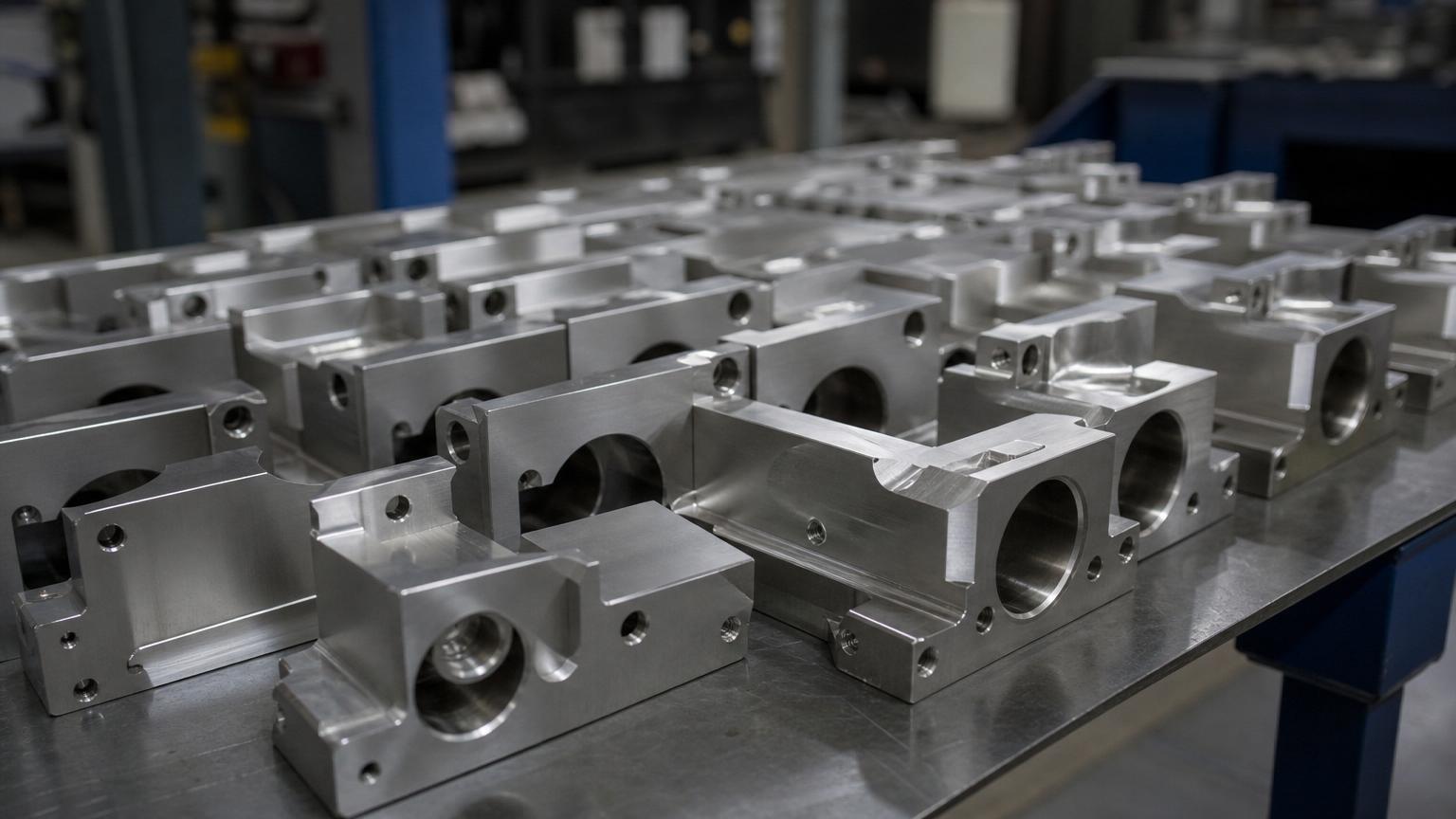
Scaling CNC Machining from Prototype to High-Volume Production: DFM Handoff, Tooling Investment, Process Qualification, and Capacity Planning for OEM Programs
Precision CNC Machining • Prototype to Production • OEM Programs
Most CNC parts do not fail in prototype. They fail in the transition to production — when the process that made ten good parts has to make ten thousand.
Hanover, PA — Olympus Machining LLC · ITAR registered · CAGE 9V9P0 · CMMC Level 1 · AS9100D In Progress.
Author: Olympus Machining Engineering Team · Reading time: ~9 min
At a Glance
- The prototype-to-production transition is a design freeze, a tooling investment, and a process qualification — not a volume ramp
- DFM feedback delivered at quote — not at PPAP — is what keeps parts printable at production cost
- Dedicated soft jaws, hard jaws, and fixture plates cut cycle time 30–60% versus prototype vise setups
- PPAP Level 3 and AS9102 Rev C FAI are the standard qualification packages for automotive and aerospace, respectively
- A Cpk of 1.33 is the accepted floor for critical characteristics; 1.67+ is expected on safety-of-flight features
- 8-point buyer checklist and 6-question FAQ at the bottom of this post
Most CNC parts do not fail in prototype. They fail in the transition to production — when the process that made ten good parts has to make ten thousand, at a price point that assumes production tooling, dedicated fixtures, and repeatable setups. The engineering effort in scaling a CNC part is rarely about the machining itself; it is about locking down every variable that a one-off prototype was allowed to leave floating.
This post walks through what changes between a prototype run and a production run, where the transition typically breaks, and what an OEM program manager should expect from a supplier that has actually done it — grounded in AS9102, PPAP, and shop-floor practice.
What Actually Changes Between Prototype and Production
A prototype run is optimized for speed of first article. It typically uses vise workholding, general-purpose cutters, conservative feeds and speeds, and probing at every setup. A single skilled machinist can babysit the job. The tolerances are held by watching the CMM report and dialing in offsets between parts. That is fine for ten units. It does not survive a thousand.
Production requires a different toolkit: dedicated soft or hard jaws, purpose-built fixture plates, validated tool libraries, standardized offsets, tool-life management, in-process gauging, and a control plan that specifies what gets measured, how often, and by whom. The goal shifts from "make a good part" to "make every part good, on any shift, with any qualified operator." That is a design problem in its own right — sometimes called production engineering — and it is the single biggest reason parts get quoted twice: once as a prototype and again for production.
DFM Handoff and Design Freeze
Design for Manufacturability (DFM) is the highest-leverage step in the entire transition. A tolerance that is achievable at prototype cost may not be achievable at production cost — not because the shop cannot hold it, but because holding it at production cadence requires additional operations, in-process gauging, or a different material. DFM feedback should come at quote, not at PPAP submission. By PPAP, the design is frozen and every change is an engineering change order (ECO) with schedule and cost impact.
Typical DFM callouts on a scaling review include: converting non-critical tight tolerances to standard tolerance blocks (±0.005″ instead of ±0.0005″), consolidating datums to avoid stack-up, adding tooling reliefs, specifying accessible surface-finish callouts, replacing broached features with milled equivalents, and flagging any feature that requires a fifth-axis setup for a decision on whether the volume justifies the machine time. Each of these has a direct impact on cycle time, scrap rate, and unit price.
Once DFM is closed out, the drawing gets a design freeze revision. From that revision forward, every dimensional characteristic on the drawing is a controlled feature under the supplier's quality system. See our related field guide, Traceability in Aerospace and Defense CNC Machining, for how revision control ties into material and process traceability.
Tooling and Fixture Investment
Production workholding is where cycle time is won. Soft jaws bored to the part contour eliminate the alignment step at every load. Dedicated fixture plates with locating pins and quick-release clamps drop a load-and-unload from minutes to seconds. For families of parts, a modular fixture plate with common bolt patterns lets one setup serve multiple part numbers. On an aluminum bracket that ran 12 minutes cycle time in a prototype vise, a dedicated fixture plate with soft jaws and a stop pin routinely brings it to 5–7 minutes — a 40–60% reduction that comes almost entirely from setup and re-clamp elimination.
Cutter selection also shifts. Prototype work often uses general-purpose end mills and drills; production work uses dedicated cutters chosen for tool life and chip evacuation at the specific feeds and speeds the process demands. Tool-life monitoring — either via cycle counting in the control or spindle-load monitoring — replaces the machinist's ear as the failure detector. A cutter that runs 200 parts between changes and never surprises anyone is worth more than a cutter that runs 500 parts on average and occasionally breaks in the middle of a lot.
Fixture and tooling investment is typically amortized over the expected annual volume. A $3,500 fixture that removes 4 minutes of cycle time from a 10,000-piece annual program pays back in labor and machine time inside the first quarter. Buyers should expect a supplier to show that math at the quote.
Process Qualification: PPAP, FAI, and Run-at-Rate
Aerospace and defense programs qualify a production process through the AS9102 Rev C First Article Inspection. Automotive programs typically use PPAP (Production Part Approval Process), most often Level 3 for new parts. Both frameworks answer the same question in different notation: does the production process, running production tooling on production equipment with production operators, produce parts that meet the drawing across a representative run?
A properly executed FAI or PPAP includes: dimensional layout of every characteristic on the drawing (100% of Form 3 on AS9102), material and process certifications, control plan, process flow diagram, PFMEA, gauge R&R for critical measurements, initial capability study on key characteristics, and sample parts. The "run-at-rate" element — sometimes a separate deliverable, sometimes rolled into the PPAP — validates that the process holds tolerance at production cadence, not just when a careful engineer runs one part slowly.
Skipping run-at-rate is the most common cause of a launch that produces good FAIR parts and then bleeds scrap in the first production lot. The prototype process was never stress-tested. Buyers should confirm that any first production lot is a genuine run-at-rate, not a re-shoot of the FAI setup.
Statistical Process Control and Cpk
Once a process is qualified, statistical process control (SPC) keeps it in control. Critical characteristics — usually flagged with a diamond or triangle on the drawing — are measured on a sampling plan and plotted on X-bar and R charts. Process capability is quantified as Cpk: the distance from the process mean to the nearest tolerance limit, divided by three standard deviations. A Cpk of 1.00 means the process just barely fits inside tolerance; 1.33 is the accepted industry floor for critical characteristics; 1.67 or higher is expected on safety-of-flight and life-limiting features.
A supplier running a Cpk of 1.67 on a critical dimension will produce about 0.6 defective parts per million on that feature — good enough that the failure mode is almost always operator error or tooling wear, both of which the control plan catches. A Cpk of 1.00 will produce about 2,700 defects per million. The difference is not in the machine. It is in the discipline of the process controls.
Capacity Planning and Scheduling
Production commitments are only as good as the capacity behind them. A supplier committing to 500 parts per month against an eight-minute cycle time needs about 67 spindle-hours per month on the qualified machine — plus setup, plus inspection, plus contingency for tool changes and preventative maintenance. Buyers should ask for a capacity model, not a commitment. A capacity model shows the machines, shifts, and cycle time behind the number; a commitment is a promise with no supporting math.
Second-source qualification is worth discussing at the same time. For programs where a single-supplier stoppage is unacceptable, running a parallel qualification on a second machine — either at the same supplier or at a partner shop — keeps the option open without paying to run parallel production. See Prototype to Production for the workflow Olympus uses when a program requires dual-source capability.
How Olympus De-Risks the Transition
Olympus Machining runs prototype and production on the same shop floor, on the same Haas VF-series milling centers and multi-axis lathes. That is deliberate: the process a customer signs off at FAI is the process that runs at rate, because the machines, operators, and inspection routines do not change. Dedicated fixturing is designed by the same engineer who programs the CAM, so the fixture and the toolpath are optimized together, not sequentially.
Inspection is anchored on our Haas HMM 430 and Chien Wei CWB-450-CNC CMMs. Critical characteristics are exported to SPC after each subgroup, and the control plan is a working document — updated when tool changes, cutter grades, or capability studies reveal a drift. AS9102 Rev C FAIRs, PPAP-aligned packages, material certifications, and run-at-rate reports are all produced on request.
For aerospace, defense, robotics, medical-device, and industrial OEM programs looking to move from prototype validation into low- to mid-volume production (typically 500 to 25,000 pieces per year per part number), Olympus is set up for the transition — DFM at quote, dedicated tooling amortized over the volume, and process qualification that reflects how the parts will actually be made.
8-Point Buyer Checklist for Prototype-to-Production Transitions
- DFM feedback delivered at quote. Not at PPAP, and not verbally.
- Design freeze revision on the drawing. Every subsequent change is an ECO.
- Dedicated fixturing and tooling identified. With amortization math shown against the annual volume.
- Control plan and PFMEA on the deliverables list. Not just at the supplier's discretion.
- Gauge R&R on critical measurements. Especially any characteristic measured on a manual gage.
- Run-at-rate report separate from FAI. Confirms cadence, not just first-article capability.
- Cpk ≥ 1.33 on critical characteristics. ≥ 1.67 on safety-of-flight features.
- Capacity model with machines, shifts, and cycle time. Not just a monthly commitment number.
FAQ
When should DFM feedback happen on a prototype-to-production program?
DFM feedback should be delivered with the initial quote — before prototype parts are cut. Feedback delivered at PPAP is too late: the design is frozen and every change is an engineering change order with schedule and cost impact. A shop that quotes without reviewing the print for manufacturability is quoting the drawing, not the part.
What is the difference between FAI and PPAP?
FAI (First Article Inspection, typically AS9102 Rev C) is the aerospace and defense standard for verifying that a first production part meets every drawing characteristic. PPAP (Production Part Approval Process) is the automotive equivalent, most commonly executed at Level 3, and includes a broader documentation package (control plan, PFMEA, gauge R&R, capability studies) in addition to the dimensional layout.
What Cpk should I require on my critical characteristics?
Cpk ≥ 1.33 is the widely accepted industry floor for critical characteristics — this corresponds to roughly 64 defects per million. Cpk ≥ 1.67 is expected on safety-of-flight, life-limiting, or life-critical features (roughly 0.6 DPMO). A supplier reporting Cpk ≥ 2.00 is running a well-instrumented process with meaningful margin.
Why is a run-at-rate different from a first article?
A first article validates that the process can produce a compliant part; a run-at-rate validates that the process holds tolerance at production cadence. The FAI is often run with an engineer watching every step. The run-at-rate is run at production speed, on a production shift, with production operators. Programs that skip run-at-rate routinely produce a good FAIR and then bleed scrap in the first production lot.
How does dedicated fixturing reduce unit cost at production volumes?
Dedicated fixturing eliminates the alignment, indication, and re-clamp steps that dominate cycle time on prototype vise setups. On typical aluminum brackets and steel housings, a purpose-built fixture plate with soft jaws and stop pins reduces cycle time 30–60%. The fixture cost is amortized against the annual volume; on a 10,000-piece program, a $3,000–$5,000 fixture typically pays back within the first production quarter.
Does Olympus Machining run prototype and production on the same machines?
Yes. Olympus runs prototype and production on the same Haas VF-series milling centers and multi-axis lathes, with inspection on our Haas HMM 430 and Chien Wei CWB-450-CNC CMMs. Keeping the process on the same equipment from prototype through production means the process a customer signs off at FAI is the process that runs at rate — no re-qualification when the volume ramps.
Ready to move your part from prototype to production?
Olympus Machining provides DFM at quote, dedicated tooling and fixture design, AS9102 Rev C FAIRs, PPAP-aligned qualification packages, and SPC-monitored production for Aerospace & Defense, robotics, medical, and industrial OEM programs.
Get a quote Prototype to Production capabilities
Related Articles
Related Capabilities from Olympus Machining
Prototype to Production
De-risked scaling from prototype validation through production runs.
Precision CNC Machining
Hanover, PA precision CNC shop for tight-tolerance aerospace and defense parts.
CNC Milling Services
Multi-axis precision milling for complex geometries and tight tolerances.
CNC Turning Services
Precision lathe machining for shafts, bushings, and cylindrical components.
Quality Assurance & Inspection
FAI, CMM verification, and process controls for production scale-up.
AS9102 First Article Inspection
AS9102 Rev C FAI services with Forms 1, 2, and 3 documentation.
Traceability in Aerospace & Defense CNC
Material certs, lot control, and AS9100D chain-of-custody for production.
Submit Your Project for Review
Contact Olympus Machining to discuss your CNC machining requirements.