What Is Precision CNC Machining? A Practical Guide to Tolerances, Capabilities, and When You Need It
CNC Fundamentals • Tolerance Capability • Field Guide
What Is Precision CNC Machining? A Practical Guide to Tolerances, Capabilities, and When You Actually Need It
A working definition of precision CNC machining from a U.S.-based precision CNC shop in Hanover, Pennsylvania — what tolerances actually mean on the shop floor, how precision differs from standard machining, and how to specify your parts so the price and lead time reflect the precision you really need.
TL;DR
- Precision CNC machining is computer-controlled milling and turning that holds tight dimensional tolerances — typically ±0.001" or better — with documented repeatability across a production run.
- The line between “standard” and “precision” is not the machine; it is the process control: slower feeds on critical features, in-process verification with calibrated instruments, and first-article inspection.
- Most parts do not need precision everywhere. Calling out tight tolerances only where they matter (bores, mating surfaces, locating features) keeps cost and lead time realistic.
- To get an accurate precision CNC quote, submit a STEP file plus a PDF drawing with explicit tolerances, GD&T, material, surface finish, and quantity.
What precision CNC machining actually means
Precision CNC machining is a subtractive manufacturing process in which a computer-controlled milling or turning machine removes material from a workpiece following a programmed toolpath. The defining attribute is not the machine itself — it is the tolerance band the process holds repeatably and the documented inspection that proves it.
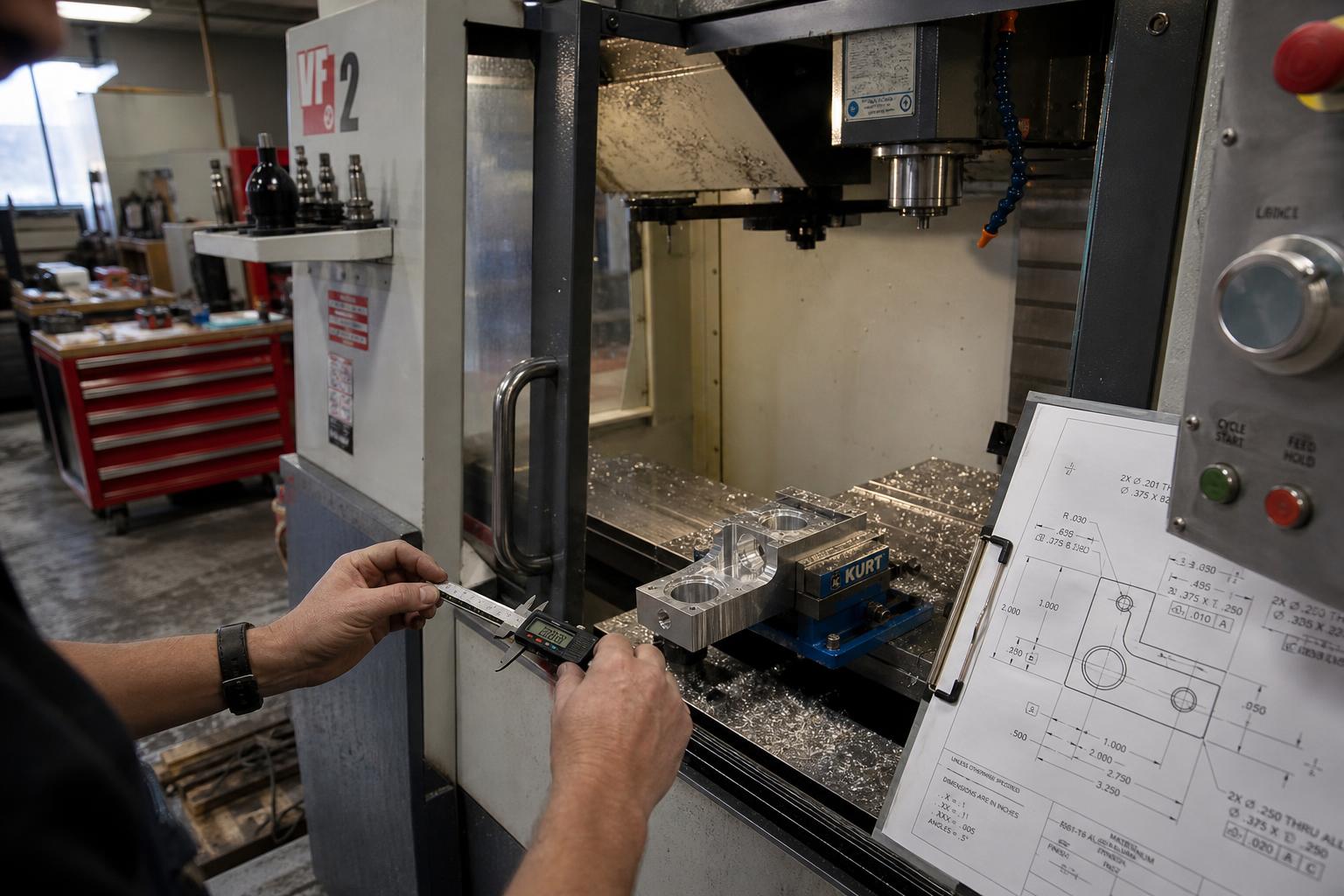
Any modern CNC mill can cut a slot. A precision CNC machine shop cuts that slot to ±0.0005", verifies the width with a calibrated bore gauge, records the result, and produces the next 99 parts the same way. The equipment matters, but the discipline matters more.
Standard vs. precision CNC machining
The practical difference shows up in three places: tolerance band, process control, and inspection.
| Attribute | Standard CNC | Precision CNC |
|---|---|---|
| Linear tolerance | ±0.005" – ±0.010" | ±0.001" – ±0.0005" |
| Hole diameter (reamed) | ±0.002" | ±0.0005" |
| Surface finish | 125 µin Ra | 32 µin Ra |
| In-process checks | End of run | Per setup, critical features |
| Inspection records | Often none | FAI, mill certs, calibration traceable |
Tighter tolerances cost more — not because the machine works harder, but because the process works harder: slower feed rates on critical features, more frequent measurement, and tighter tooling control.
When you actually need precision CNC machining
Not every part needs precision everywhere. Some good rules of thumb:
- Bearing bores and shaft fits — interference and clearance fits are sensitive to a few tenths.
- Mating surfaces on assemblies that must seal, locate, or transmit load without backlash.
- Locating features — dowel pin holes, alignment bosses, and reference surfaces that drive downstream stack-up.
- Aerospace, defense, medical, and robotics components, where failure modes are unforgiving and inspection is mandated.
The opposite case is just as important. Brackets, covers, and non-critical structural parts rarely need ±0.0005" anywhere on the drawing. Over-toleranced prints are one of the most common reasons quotes come back higher than buyers expect.
How precision is held on the shop floor
Holding precision is the sum of small disciplines, not a single trick. At Olympus Machining we treat every precision job as a closed loop:
- DFM review. Before we cut, we read the drawing and flag tolerance stack-ups, hard-to-hold features, and material choices that fight against the tolerance band.
- Programming. Toolpaths are written against the released drawing revision. Critical features get conservative feeds and finishing passes with sharp, dedicated tooling.
- Setup and first article. The first part is fully inspected before the run continues. If a feature is drifting, it gets corrected at part one — not part fifty.
- In-process inspection. Calibrated micrometers, bore gauges, and surface plates verify critical dimensions at defined intervals. Tool wear is tracked.
- Final inspection and documentation. Every part is measured against the drawing. For aerospace and defense work, an AS9102 First Article Inspection report ships with the parts.
Materials that machine well at precision tolerances
Tolerance capability depends as much on material behavior as on the machine. Materials we routinely run at precision tolerances:
- 6061-T6 and 7075-T6 aluminum — the workhorses. Clean chip, predictable thermal behavior, holds tenths on critical features without complaint.
- 303 / 304 / 316 stainless steel — corrosion-resistant, machines well with appropriate tooling, common for medical and food-contact parts.
- 4140 alloy steel and 17-4 PH stainless — for high-strength structural parts where stiffness matters.
- Delrin (acetal) and PEEK — the engineering plastics that hold tolerance. Softer plastics drift too much to spec at precision levels.
- Brass and copper alloys — common in fluid system and electrical components.
How to specify a precision CNC part on the drawing
The drawing — not the model — governs the part. A few practical specification rules that consistently produce parts that pass FAI on the first try:
- Call out a default tolerance block on the drawing title block, then override only the features that need tighter control.
- Use GD&T for what matters — true position on bolt patterns, perpendicularity on mating faces, profile on contoured surfaces. Plus-minus everything is rarely the right answer.
- Specify surface finish in Ra microinches on critical surfaces, not just “machined finish.”
- Name the exact material — “6061-T6 per ASTM B221” is unambiguous; “aluminum” is not.
- Send STEP + PDF. The STEP carries geometry; the PDF carries intent. See our guide on STEP files for CNC quotes.
What to ask a precision CNC machine shop before you place an order
- What tolerances do you routinely hold in production — not in theory?
- What inspection equipment is calibrated, and is calibration traceable to NIST?
- Do you provide first-article inspection reports? AS9102 if needed?
- Are you ITAR registered and CMMC compliant for defense work?
- What CAM software do you run, and what CAD formats do you accept?
- Will I work directly with a machinist or only with a sales rep?
The answers separate shops that machine precision parts from shops that talk about it.
Precision CNC machining at Olympus Machining
Olympus Machining LLC is a U.S.-based precision CNC machine shop in Hanover, Pennsylvania. We run multi-axis CNC milling and turning for prototype through low-volume production, with documented inspection and direct machinist-to-engineer communication on every project. We are ITAR registered, CMMC Level 1 compliant, and aligned with FAR 52.204-21. See full capabilities on the Precision CNC Machining services page.
Contact
Have a precision CNC project? Send a STEP file and a PDF drawing to info@olympusmachining.com or call (717) 634-5094. We typically return quotes in 24–48 hours.
About Olympus Machining
Olympus Machining LLC is a U.S.-based precision CNC machine shop located in Hanover, Pennsylvania. We serve OEMs and engineering teams across aerospace, defense, robotics, and industrial manufacturing with tight-tolerance, low-volume, and time-sensitive parts.
Related Articles
Related Capabilities from Olympus Machining
Prototype to Production
De-risked scaling from prototype validation through production runs.
CNC Milling Services
Multi-axis precision milling for prototype and production parts.
CNC Turning Services
Precision lathe machining for shafts, bushings, and turned features.
Quality Assurance & Inspection
FAI, CMM verification, and process controls for production scale-up.
Submit Your Project for Review
Contact Olympus Machining to discuss your CNC machining requirements.