CNC Turning for Medical Device OEMs: Materials, Tolerances, and Documentation
CNC Turning • Medical Devices • Materials & Documentation
Most metal and polymer parts inside a medical device start life on a lathe. Getting them right is a materials, tolerance, and paperwork problem at the same time.
Hanover, PA — Olympus Machining LLC · ITAR registered · CAGE 9V9P0 · CMMC Level 1 · ISO 13485 on roadmap; ISO 9001-aligned controls today.
Author: Olympus Machining Engineering Team · Reading time: ~11 min
At a Glance
- Bone screws, pins, shafts, cannulated parts, fluid fittings, and instrument handles are all rotational parts — CNC turning is the default process
- Common medical turning materials: Ti-6Al-4V and CP titanium, 316L, 17-4 PH, CoCr, PEEK and PEEK-CF30
- Olympus turns bar-fed work to 1.5 inch diameter with live tooling, holding ±0.0005 inch on diameters and lengths and finishes to 8 Ra on request
- Documentation matters as much as dimensions: material certs, lot traceability, CMM data, and FAI reports
- Olympus is not ISO 13485 certified — ISO 13485 is on our roadmap, with ISO 9001-aligned controls today
- RFQ checklist and 7-question FAQ at the bottom of this post
Medical device engineers and sourcing managers spend a lot of time on the parts that are hard to make: the complex housing, the patient-specific guide, the multi-axis implant trial. Yet when you look at a bill of materials for a surgical instrument set, a drug-delivery device, or an orthopedic system, the majority of machined line items are round. Pins, shafts, screws, bushings, fittings, and handles. Those parts come off a lathe.
Because they look simple, turned medical components are often sourced as commodities. That is where programs get hurt. A pin that is 0.0004 inch oversize will not seat. A cannulated shaft with a burr inside the bore will fail cleaning validation. A titanium part shipped without a heat-traceable material cert cannot go into a clinical build. This guide covers what medical OEMs and startups should expect from a CNC turning supplier: which materials behave how, what tolerances are realistic, when to turn versus mill, and which documents should ship with the parts.
It is written from the perspective of a precision job shop in Hanover, Pennsylvania that turns medical components for OEMs and contract manufacturers. Where we describe our own capability, we stick to what we actually do. Where we describe industry practice, we say so.
1. Why Turned Parts Dominate Medical Devices
Medical devices are full of rotational geometry because the human body and the instruments that work in it favor cylinders. Bones are drilled with round holes. Fluids move through round tubes. Surgeons grip round handles. Typical turned medical components include:
- Bone screws and screw trials — threaded shanks, driver recesses, and controlled head geometry. Trial versions used for sizing during surgery are a common job-shop part.
- Pins and guide wires — small diameters, long length-to-diameter ratios, and tight straightness and diameter requirements.
- Shafts and drive components — instrument shafts, powered-handpiece spindles, and couplings that need concentric diameters and clean shoulders.
- Cannulated parts — hollow screws, drills, and shafts that pass over a guide wire. The through-bore is the hardest feature: it must be straight, concentric, and burr-free.
- Fluid fittings — luer-style connectors, manifold ports, and threaded fittings for diagnostic and fluid-handling equipment, where sealing surfaces and thread quality drive function.
- Instrument handles — turned bodies with knurling, grip grooves, and milled flats or cross holes added with live tooling.
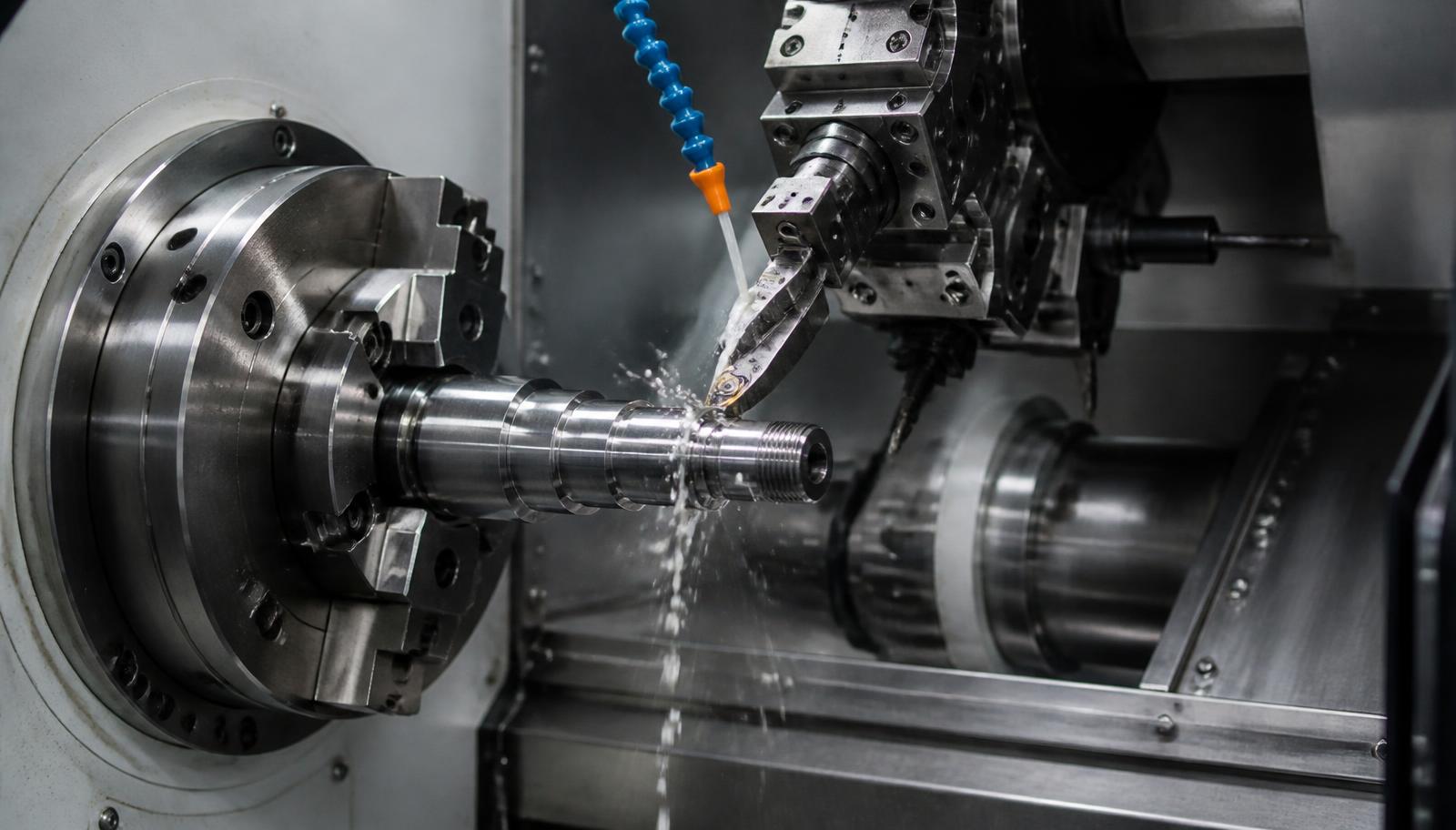
Turning wins on these parts because the spindle generates the critical features — diameters, bores, shoulders, threads — around a single axis of rotation in one clamping. That keeps diameters concentric to each other by construction rather than by careful re-fixturing. For an overview of how we approach general turning work, see our precision CNC turning capabilities article; the rest of this post focuses on what changes when the part is going into a medical device.
2. Materials for Medical CNC Turning
Material choice is usually fixed by the device design and the customer's biocompatibility file, not by the machine shop. The shop's job is to buy the right certified bar, machine it without damaging it, and keep it from being contaminated. Our medical-grade alloys page has detailed specifications; here are the machining-relevant points.
Ti-6Al-4V and CP Titanium
Ti-6Al-4V (Grade 5, and ELI where specified) is the workhorse for implant trials, instrument components, and dental parts. CP titanium (Grades 1–4) is softer and more ductile. Both have low thermal conductivity, so heat concentrates at the cutting edge; both are gummy enough to form stringy chips and edge burrs if tools are dull or feeds are too light. Sharp positive-rake inserts, steady chip loads, and high-pressure coolant matter more here than raw spindle speed. Our titanium CNC machining guide covers tooling and parameters in more depth.
316L and 17-4 PH Stainless
316L is used where corrosion resistance and a long history in medical applications matter — fittings, handles, and many reusable instrument parts. It work-hardens, so interrupted or rubbing cuts make each following pass harder; the fix is to keep the tool engaged and avoid dwell. 17-4 PH is chosen when an instrument needs higher strength or hardness after heat treatment. Turning before or after aging changes tool life and final size, so the drawing should state the heat-treat condition at machining. If you are deciding between stainless grades, our 304 vs 316 stainless steel comparison explains the trade-offs.
Cobalt-Chromium (CoCr)
CoCr alloys are hard, abrasive, and tough on tooling. They are used where wear resistance is critical. Expect slower cutting, more frequent insert changes, and a higher price per part than titanium. Small features in CoCr should be discussed at the quote stage so tool access and cycle time are realistic.
PEEK and PEEK-CF30
PEEK is radiolucent, chemically resistant, and used for housings, spacers, and instrument components. Unfilled PEEK machines cleanly but can move after machining if internal stresses are not managed — annealed stock and balanced material removal help hold size. PEEK-CF30 (30% carbon fiber) is stiffer and more abrasive; it wears tools faster and can fray at edges if tools are not sharp. See our PEEK CNC machining page for details.
Burr Control
Burrs are a functional defect in medical parts, not a cosmetic one. A burr inside a cannulated bore can shed particles, trap debris, or prevent a guide wire from passing. Good burr control starts with toolpath design — chamfer and break edges in the program, back-chamfer cross holes with live tooling, and plan the last pass so the tool exits into air rather than tearing the edge. Manual deburring is still used, but it should be the backup, not the strategy, and any critical edge condition should be called out on the drawing.
Preventing Cross-Contamination
When a customer's specification requires it, tooling, coolant, and packaging are controlled to prevent cross-contamination from non-medical alloys. In practice that means dedicated or cleaned tooling, purged coolant or segregated machines between alloy families, separated chips, and clean packaging. If your program has a specific requirement — for example, no contact with leaded brass or free-machining steels — put it on the purchase order so it can be scoped and priced.
3. Tolerances and Surface Finish
Medical drawings often carry tighter tolerances than the function needs, because a designer copied a title block or wanted margin. Tight tolerances cost money: more inspection, more scrap risk, longer cycle times. The best results come from tightening only the features that drive fit and function.
Realistic Diameter and Concentricity Targets
On our bar-fed turning work up to 1.5 inch diameter, we hold ±0.0005 inch on diameters and lengths where the print requires it. Concentricity and runout between diameters turned in the same setup are typically excellent because they share one axis of rotation; they become harder when features are split across two setups or when a part is re-chucked. If two diameters must be concentric, call out the relationship with GD&T and keep both features in one operation where possible. For the shop-floor side of holding these numbers, see machining strategies for ±0.0005 inch tolerance.
Surface Finish (Ra) Targets
As-turned surfaces on metals generally fall in the 32–125 Ra (microinch) range depending on material, tool, and feed. Fine finishing passes improve that, and we can reach 8 Ra on request. Passivation, electropolish, or anodize are available through qualified finishing partners. Specify Ra only where it matters — sealing surfaces, bearing fits, and tissue-contact surfaces — and state the measurement method. Our CNC machining surface finish guide explains Ra, Rz, and how to specify them.
Thin Walls and Small Diameters
Thin-walled tubes and small pins deflect under cutting force. That shows up as taper, out-of-round, or chatter marks. Mitigations include tailstock or guide support, lighter finishing passes, sharp tools, and balanced roughing so stress relief does not move the part after release. If your design has a wall under roughly 10% of diameter or a length-to-diameter ratio above about 4:1, flag it at the quote stage so the supplier can confirm workholding before you commit to a schedule.
Live Tooling: Features in One Setup
Live tooling lets the lathe drill cross holes, mill flats, cut hex drives, and add slots without moving the part to a mill. For medical parts, that matters for two reasons: features stay accurately located to the turned diameters, and fewer handling steps mean less chance of damage or contamination. Our turning work uses live tooling for milled features in the same setup.
4. Turning vs. Milling vs. Mill-Turn for Medical Geometries
The right process depends on where the critical geometry lives. Use this table as a starting point:
| Factor | CNC Turning | CNC Milling | Turning with Live Tooling (Mill-Turn) |
|---|---|---|---|
| Best geometry | Pins, shafts, screws, bushings | Housings, guides, blocks, plates | Round parts with flats, cross holes, hex drives |
| Concentricity | Excellent (single axis) | Depends on fixturing | Excellent, features located to diameters |
| Setups | One, sometimes two | Often several | Usually one |
| Handling / contamination risk | Low | Higher with more setups | Low |
| Typical medical parts | Guide pins, screw trials, fittings | Cutting guides, PEEK housings | Cannulated drivers, instrument handles |
| Cost driver | Cycle time, material | Setups, fixtures | Cycle time, programming |
Many medical parts are hybrids. A turned handle with a milled flat and a cross hole belongs on a lathe with live tooling. A block-shaped orthopedic guide with one turned boss belongs on a mill. When the answer is unclear, send the model and ask the supplier to explain their proposed process — the reasoning tells you a lot about how they will hold your critical features. Our medical device CNC machining page covers the milled side of our medical work.
5. Inspection and Documentation
For medical OEMs, the documentation package is part of the product. A dimensionally perfect part with missing paperwork cannot be used in a regulated build. Here is what a turned-parts supplier should be able to provide, and what we provide today.
- Material certifications — mill certs with heat/lot traceability are provided with every order, traceable back to the raw material supplier and retained under our document-control procedure.
- Lot traceability — lot numbers tie each shipment to its material heat, job record, and inspection data. For more on how this works, see traceability in CNC machining; the same principles apply to medical programs.
- CMM and dimensional reports — inspection records, including CMM data and dimensional reports, are included in FAI packages. Turned diameters are also verified with micrometers, bore gauges, and thread gauges.
- First article inspection — AS9102-style FAI reports (balloon drawing, characteristic accountability, and results) work well for medical development and pre-clinical builds, even though AS9102 is an aerospace standard. Our CMM inspection report checklist lists what a complete report should contain.
- Certificate of Conformance — available on request.
- Cleaning and packaging notes — state any cleaning, bagging, or labeling requirement on the PO. Final cleaning for implantable or sterile use is normally done by the OEM or a specialist cleaning and packaging provider, not the machine shop; the shop should deliver parts free of chips, burrs, and visible residue in clean packaging.
Quality system status: Olympus Machining is not ISO 13485 certified. ISO 13485 is on our roadmap; we operate ISO 9001-aligned controls today. We do not hold FDA registration as a device manufacturer — we supply machined components to OEMs and contract manufacturers who own the device design and regulatory file. Many medical OEMs accept this for development, prototype, and pre-clinical work; confirm your program's documentation needs at the quoting stage.
6. Prototype → Pilot → Production for Clinical Builds
Medical programs rarely jump from a CAD model to production. They move through stages, and each stage has different goals:
- Prototype (1–10 parts). Fit checks, bench testing, and design iteration. Speed and design-for-manufacturability feedback matter most. This is the time to ask which tolerances are driving cost.
- Pilot / clinical build. Parts for verification testing, cadaver labs, or early clinical use. The design should be frozen enough that the process can be documented: same material source, same program, same inspection plan. FAI is performed here so later lots can be compared to an approved baseline.
- Production. Repeat lots run from documented setups, controlled tooling, and the approved inspection plan, with first-article results as the reference. Production quantities from 25 to several hundred pieces are handled regularly.
The most common mistake is changing something between stages without telling anyone — a different bar supplier, a revised program, a new finishing vendor. For medical work, any process change after the pilot build should go back through the customer for approval. Ask your supplier how they control and communicate changes.
7. RFQ Checklist: What to Send
A complete request for quote gets you an accurate price and a realistic schedule the first time. Send:
- STEP model + PDF drawing — the model defines geometry; the drawing defines tolerances, GD&T, finish, and notes. If they conflict, say which controls.
- Material specification — alloy, grade, condition, and governing standard (for example, Ti-6Al-4V ELI per a named ASTM spec), plus any approved-source requirement.
- Critical features — identify the dimensions that drive function so inspection focuses there.
- Quantity and stage — prototype, pilot, or production, plus expected annual volume.
- Finishing — passivation, electropolish, anodize, or laser marking, with specifications.
- Cleanliness and packaging requirements — contamination controls, bagging, labeling, and any restricted materials.
- Documentation needed — material certs, FAI, CMM report, CoC, and any customer-specific forms.
Request a Quote for Turned Medical Components
Send your STEP file, drawing, material spec, and quantity. We will review manufacturability, confirm what documentation we can provide, and respond with a quote.
Request a quoteFrequently Asked Questions
Does Olympus Machining provide CNC turning for medical device OEMs?
Yes. We provide precision CNC turning for medical device OEMs and contract manufacturers — surgical instrument components, implant trial components, fluid-handling parts, and diagnostic equipment parts — on bar-fed turning to 1.5 inch diameter with live tooling.
Is Olympus Machining ISO 13485 certified?
No. ISO 13485 is on our roadmap; we operate ISO 9001-aligned controls today. Many OEMs accept this for development, prototype, and pre-clinical work. Confirm your program's requirements at the quote stage.
What materials do you turn for medical parts?
Ti-6Al-4V and CP titanium, 316L and 17-4 PH stainless, cobalt-chromium, PEEK, and PEEK-CF30, plus other biocompatible polymers per customer specification.
What tolerances can you hold on turned medical components?
We hold ±0.0005 inch on diameters and lengths where required, and can achieve surface finishes to 8 Ra on request. Thin walls and small, long parts should be reviewed at the quote stage.
Do you provide material traceability?
Yes. Material certifications with heat/lot traceability are provided with every order, and FAI and inspection records are available.
How do you prevent cross-contamination between alloys?
When the customer's specification requires it, tooling, coolant, and packaging are controlled to prevent contamination from non-medical alloys. State the requirement on the PO so it can be scoped.
Do you clean and sterile-package parts?
No. We deliver parts free of chips and burrs in clean packaging per your requirements. Final cleaning and sterile packaging for implantable or sterile use are normally handled by the OEM or a specialist provider.
Contact Olympus Machining
Olympus Machining LLC
639 Frederick St, Suite 1
Hanover, PA 17331
Phone: (717) 634-5094
Website: www.olympusmachining.com
Google Business Profile:
View on Google
Request a Quote:
Submit a project
About Olympus Machining
Olympus Machining LLC is a precision CNC machining shop located in Hanover, Pennsylvania. We provide CNC milling, CNC turning, and prototype-to-production services for OEMs and manufacturers nationwide. Olympus is ITAR registered (CAGE 9V9P0) and CMMC Level 1. ISO 13485 is on our roadmap; ISO 9001-aligned controls today.
Related Articles
Related Capabilities from Olympus Machining
Precision CNC Machining
Hanover, PA precision CNC shop for tight-tolerance aerospace and defense parts.
CNC Milling Services
Multi-axis precision milling for complex geometries and tight tolerances.
CNC Turning Services
Precision lathe machining for shafts, bushings, and cylindrical components.
Surface Finish Requirements
Ra, Rz, and what aerospace buyers actually need to specify.
Aerospace Machining Tolerances Explained
How aerospace tolerance callouts drive process selection and cost.
Holding 0.0001" Tolerances
Shop-floor strategies for tenth-thousandth aerospace tolerance work.
Machining Strategies for 0.0005" Tolerance
Process planning and workholding for half-thou tolerance callouts.
CMM Inspection Capabilities & Reporting
How CMM reporting proves the tolerances your drawing calls out.
Traceability in Aerospace & Defense CNC
Material certs, lot control, and AS9100D chain of custody.
Scaling Prototype to High-Volume Production
DFM handoff, tooling investment, and process qualification for OEM programs.
AS9102 First Article Inspection Checklist
Forms 1, 2, and 3 characteristic accountability on first articles.
STEP Files for CNC Machining Quotes
How to export CAD data that quotes accurately the first time.
Inconel CNC Machining Guide
When Inconel 718 is functionally required — and what it costs to machine.
Delrin (Acetal/POM) Machining Guide
Low-cost precision plastic components for non-metallic applications.
ITAR CNC Machining, Mid-Atlantic
ITAR-registered machining for Mid-Atlantic aerospace and defense programs.
Submit Your Project for Review
Contact Olympus Machining to discuss your CNC machining requirements.