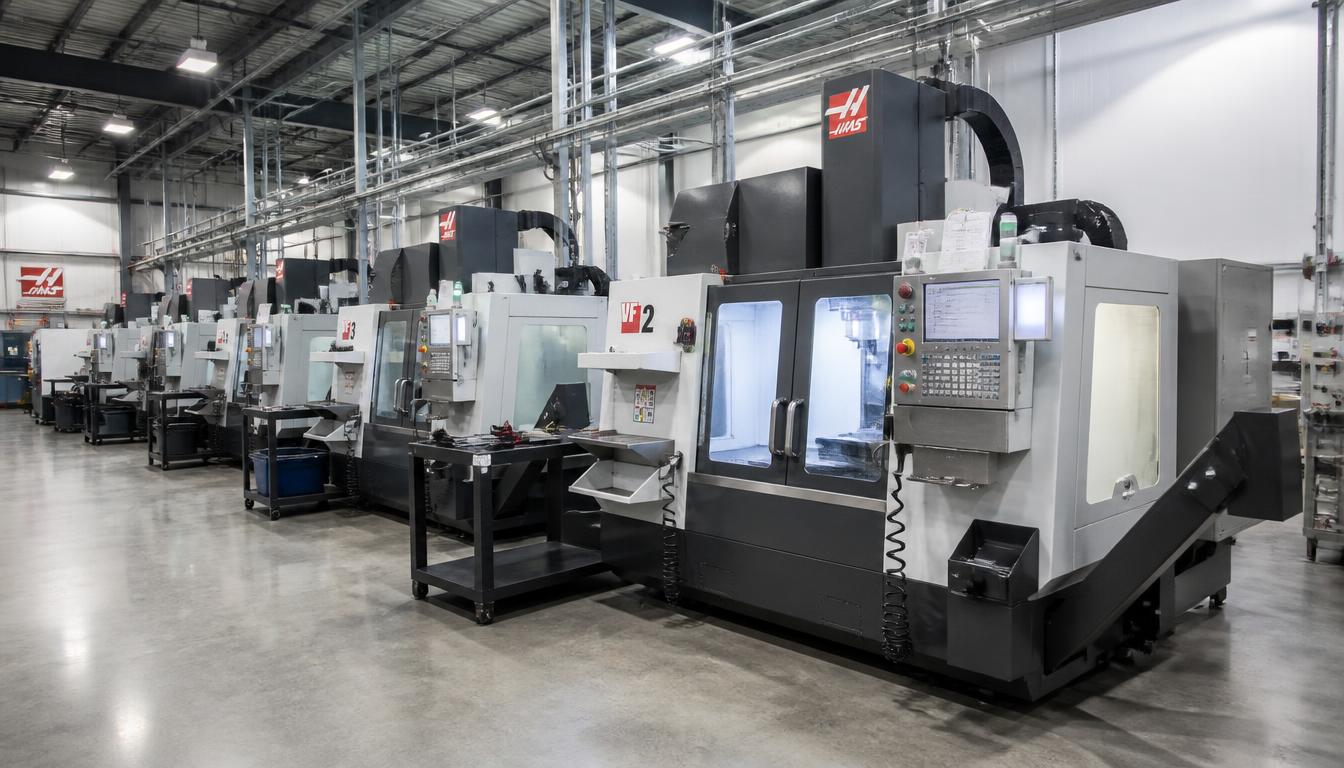
A Guide to Commercial-Grade CNC Machine Tools in Modern Manufacturing
Machine Selection • Buyer Education • Aerospace, Defense & Industrial OEMs
A supplier capability list is only useful if you can translate machine specifications into part-quality confidence.
Hanover, PA — Olympus Machining LLC · ITAR registered · CAGE 9V9P0 · CMMC Level 1 · AS9100D In Progress.
Author: Olympus Machining · Reading time: ~9 min
At a Glance
- "Commercial-grade" describes machines purpose-built for daily production, not a marketing label
- Five specifications matter most: spindle rigidity, thermal stability, way construction, control system, tool changer capacity
- Spindle taper (CAT 40, CAT 50, BT 40, HSK 63A/100A) is a fast tier indicator during an audit
- A dedicated, calibrated CMM — separate from the machines that cut the parts — is non-negotiable for production inspection
- Equipment alone does not deliver tolerance; programming, fixturing, operators, and the quality system do the rest
- 7-step supplier equipment audit checklist and an 8-question FAQ below
Every OEM procurement team has received the same document: a supplier capability sheet with a list of machine names, a few spindle speeds, and a work-envelope table. What that sheet almost never explains is how any of it translates into a part that holds its print on the five-hundredth unit as reliably as it did on the first. Machine names are not capability. Specifications are not capability either, until someone connects them to the tolerances, finishes, and repeatability your drawing demands.
The phrase "commercial-grade CNC machine tools" sits at the center of that translation problem. It is used loosely across the industry, sometimes to describe anything with a control panel and an enclosure. Used precisely, it identifies a specific tier of equipment: machines engineered to run production shifts, day after day, holding position while they heat, vibrate, and cut. That tier is where tolerance-critical aerospace, defense, and medical work belongs.
This guide explains what the commercial-grade tier actually is, the five specifications that define it, how to verify it during supplier qualification, and — just as importantly — what a good machine cannot fix. It is written for engineers and procurement professionals evaluating precision CNC machining suppliers, not for anyone shopping for a machine.
What Does "Commercial-Grade CNC Machine Tools" Actually Mean?
CNC equipment falls into four rough tiers. Each tier is designed for a purpose, and none of them is inherently bad — they simply answer different questions.
Hobby / desktop machines generally sit under $10,000. They have limited structural rigidity, little to no thermal management, and hold accuracy only under ideal conditions with light cuts. They are built for makers, education, and one-off soft-material work, not for production parts on a print.
Prosumer / benchtop machines run roughly $10,000 to $50,000. Rigidity improves, enclosures and real controls appear, and the machines become genuinely useful for teaching labs, fixture parts, and some low-volume prototyping. Work envelopes stay small and thermal compensation stays minimal.
Commercial-grade machines run roughly $75,000 to $500,000 and up. They are purpose-built to cut metal every day: heavy cast-iron or polymer-composite structures, pre-loaded precision ballscrews, hardened linear guides or box ways, thermal compensation, industrial control systems, high-speed automatic tool changers, and through-spindle or high-pressure coolant. This is the tier that supports tight-tolerance production work and the tier most reputable job shops build their floor around.
Enterprise / heavy industrial machines run $500,000 to several million dollars: large gantry mills, multi-pallet flexible manufacturing cells, horizontal machining centers with automated pallet pools, and specialty 5-axis platforms for aerospace primes and high-volume programs.
Most shops serving aerospace, defense, and medical OEMs operate primarily in the commercial-grade tier, adding select enterprise machines where part size or volume requires them. Understanding that distribution is what lets you read a capability list correctly.
The Five Specifications That Define Commercial-Grade
COMMERCIAL-GRADE CNC MACHINE ANATOMY
━━━━━━━━━━━━━━━━━━━━━━━━━━━━━━
  1. Spindle rigidity         →  Cutting force + finish
  2. Thermal stability        →  Repeatability over shift
  3. Way construction         →  Positioning accuracy
  4. Control system           →  Program precision + probing
  5. Tool changer capacity    →  Setup reduction + throughput
━━━━━━━━━━━━━━━━━━━━━━━━━━━━━━
Spindle Rigidity and Power
Commercial-grade spindles typically deliver 10 to 40+ horsepower through a cartridge assembly with pre-loaded angular-contact bearings, either direct-drive for high RPM or belt-driven for low-end torque. Rigidity governs how aggressively you can engage the cutter without chatter, which in turn governs cycle time, tool life, and the finish you can hold without a secondary operation. A rigid spindle is also what makes light finishing passes predictable, since deflection under a 0.005-inch radial engagement is the difference between a clean wall and a tapered one. Finish requirements should always be read alongside spindle capability — see our guide to surface finish requirements for the specification side of that relationship.
Thermal Stability
Heat is the quiet enemy of accuracy. A spindle running at 10,000 RPM grows measurably along its axis within the first hour, ballscrews expand as they cycle, and a shop that swings twenty degrees between morning and afternoon moves its own machines. Commercial-grade platforms address this with spindle-growth sensors, ambient temperature compensation, real-time offset correction, and on premium models oil-cooled or chilled ballscrews. Climate-controlled floors and inspection rooms extend the same logic to the parts and gages themselves. This is precisely why holding ±0.0005-inch tolerances is a systems problem rather than a machine purchase, and why tenth-level work demands even tighter environmental discipline.
Way Construction — Linear Guides vs. Box Ways
Way construction determines how the machine carries load and how quickly it moves. Neither option is superior in the abstract; they are matched to a part mix.
| Attribute | Linear Guides | Box Ways |
|---|---|---|
| Rapid traverse | High (1,400–2,400+ IPM) | Moderate |
| Friction / wear | Low rolling friction | Higher sliding friction |
| Damping | Moderate | Excellent |
| Best suited to | High-speed machining, aluminum, finishing | Heavy roughing, interrupted cuts, tough alloys |
| Typical materials | 6061/7075 aluminum, plastics, mild steels | Titanium, Inconel, hardened steels |
A shop with a mixed part portfolio will usually run both configurations, and the honest answer to "which do you have?" should reference the materials and geometries they actually quote.
Control Systems
The control is the machine’s decision engine. Fanuc, Haas, Siemens, and Mitsubishi controls all set the ceiling on look-ahead block processing, high-speed contouring smoothness, macro and parametric programming, and probing integration. Look-ahead matters most on 3D surfacing, where a control that cannot buffer enough blocks will visibly slow at every corner and leave witness marks. Modern commercial-grade controls also execute on-machine probing routines that set work offsets, verify features mid-cycle, and detect broken tools before they scrap a part — a capability that feeds directly into quality assurance and CMM inspection workflows. Machines running decades-old retrofit controls are worth flagging during an audit, not because they cannot cut, but because they change what documentation and closed-loop verification are realistic.
Tool Changer Capacity and Automation
Automatic tool changer capacity determines how much work a machine can complete without operator intervention. A 20-pocket changer is workable for simple prismatic parts; 40 to 120+ pockets support multi-part families, sister tooling, and lights-out or second-shift running. Around the changer sit the other automation features that define the tier: chip augers and conveyors, high-pressure through-spindle coolant, tool-length probes, pallet or trunnion changeovers, and bar feeders on the turning side. Together they set the ceiling on unattended throughput, which is exactly the constraint that governs scaling from prototype to production and the economics discussed in our prototype-to-production overview.
How to Verify Commercial-Grade Capability in a Supplier Audit
- Request the machine list with make, model, year, and control version. A specific list is a sign of a shop that manages its assets. Vague answers such as "we run modern CNC equipment" are a red flag worth resolving before the RFQ goes out.
- Verify spindle taper and rigidity specs. CAT 40, CAT 50, BT 40, and HSK 63A/100A interfaces indicate commercial-grade platforms. Smaller tapers point toward the prosumer tier and a lighter duty cycle.
- Confirm probing and in-process verification capability. Commercial-grade shops run on-machine probing to set work offsets, verify features mid-cycle, and check tools for breakage rather than relying on operator memory.
- Ask about calibration and maintenance intervals. Annual machine calibration, documented ballbar or laser checks, and a logged preventive maintenance schedule separate a managed floor from a reactive one.
- Verify CMM capability separately. The machines that make parts should never be the only machines that measure them. A dedicated, calibrated coordinate measuring machine is required for credible production inspection — see CMM inspection capabilities and the AS9102 CMM checklist.
- Confirm environmental controls. Ask where parts are inspected and at what temperature. The tighter the tolerance, the more the answer matters.
- Ask for the chip and material segregation protocol. Shops running titanium and Inconel alongside aluminum should segregate chips by material for recycling value and, more importantly, to prevent cross-contamination on controlled alloys with traceability requirements.
These seven questions map cleanly onto the broader qualification framework in selecting a CNC machine shop for OEM parts and how OEMs evaluate CNC machine shops.
Olympus Machining’s Commercial-Grade Equipment
For transparency, here is what runs on our floor in Hanover, Pennsylvania.
Haas HMM 430 5-axis vertical machining center. CAT 40 spindle, 12,000 RPM, full simultaneous 5-axis capability through a trunnion table, thermal compensation via spindle sensors, 40+ tool automatic tool changer, and high-pressure coolant support. It handles prismatic multi-sided parts, aerospace brackets, robotics end-of-arm tooling, and the complex contoured geometries described in our 5-axis milling guide and CNC milling services page.
Chien Wei CWB-450-CNC turn-mill. Live tooling, sub-spindle, C-axis and Y-axis capability, a 12-station turret, and bar feeder support. It produces shafts, bushings, actuator housings, and turned parts with milled features completed in a single setup — the capability set covered in precision CNC turning capabilities and our CNC turning services page. When a part could reasonably go either way, the milling vs. turning decision guide walks through the tradeoffs.
Haas HM-4930 CMM. A dedicated coordinate measuring machine in a climate-controlled inspection area, calibrated annually, used for AS9102 first article inspection, dimensional verification and reporting, and traceability documentation. Supporting equipment includes a granite surface plate, height gages, micrometers, calipers, and optical comparator equipment.
All of this equipment supports ITAR-registered defense CNC machining and CMMC Level 1 alignment programs, with full details on our compliance overview. We serve OEMs across the industries we support, from Pennsylvania to Maryland and nationwide.
What Commercial-Grade Machines Don’t Fix
A half-million-dollar machining center does not make a shop capable. It raises the ceiling; everything below the ceiling is still human work.
- Programming skill. Poor toolpath strategy produces chatter, uneven tool wear, and inconsistent finishes on any machine, at any price.
- Fixturing. Workholding that lets a thin wall breathe will lose a tolerance the machine could otherwise hold all day.
- Operator skill. Setup, tool presetting, offset discipline, and in-cycle monitoring remain judgment tasks.
- Quality system. Documented processes, calibration schedules, and lot traceability are what make a good part reproducible — see our QMS overview.
- Environmental control. An excellent machine in an uncontrolled environment cannot reliably hold sub-thousandth features.
Design decisions matter just as much on the buyer’s side. Our DFM guidance for aerospace CNC parts covers the drawing-level choices that determine whether commercial-grade equipment can be used efficiently at all, and aerospace tolerances explained covers how to specify them without inflating cost.
Frequently Asked Questions About Commercial-Grade CNC Machine Tools
What does "commercial-grade" mean for a CNC machine tool?
Commercial-grade describes machines engineered for daily production use: heavy cast structures, precision ballscrews, thermal compensation, industrial controls, and high-capacity tool changers. They typically cost $75,000 to $500,000 and are built to hold tolerance across full production shifts rather than in short ideal-condition runs.
How does a commercial-grade CNC machine differ from a prosumer or hobby machine?
The difference is duty cycle and stability. Hobby and prosumer machines are designed for light cuts, education, and prototyping with limited rigidity and thermal management. Commercial-grade machines are designed to cut metal continuously while compensating for heat, load, and wear so results stay repeatable.
What spindle taper indicates a commercial-grade machine?
CAT 40, CAT 50, BT 40, and HSK 63A or 100A tapers are standard commercial-grade interfaces. They carry the tool rigidly enough for production depth of cut and support high-speed toolholders. Smaller tapers generally indicate lighter prosumer platforms intended for limited-duty work.
Does buying a commercial-grade machine guarantee tight tolerances?
No. The machine sets the ceiling, not the result. Programming strategy, workholding, tool condition, operator setup discipline, environmental control, and a documented quality system all determine whether the shop actually achieves and proves the tolerance on the print.
What role does thermal stability play in CNC machine tool selection?
Thermal growth in spindles, ballscrews, and the machine structure moves the cutting point over a shift. Commercial-grade machines counter this with growth sensors, ambient compensation, and real-time offset correction. Without it, parts drift measurably between the first and last piece of a run.
Should the machine that makes a part also measure it?
On-machine probing is valuable for setting offsets and catching problems mid-cycle, but it shares the machine’s own errors. Production inspection requires a separate, calibrated coordinate measuring machine so measurement is independent of the process that produced the feature.
What CNC machines does Olympus Machining run?
Olympus runs a Haas HMM 430 5-axis vertical machining center (CAT 40 spindle, full simultaneous 5-axis with trunnion) and a Chien Wei CWB-450-CNC turn-mill (live tooling, sub-spindle, C-axis and Y-axis capability). Inspection is on a Haas HM-4930 CMM in a climate-controlled area.
How do I audit a supplier’s CNC equipment during qualification?
Request a machine list with make, model, year, and control version; verify spindle tapers; confirm probing capability; review calibration and maintenance records; verify an independent CMM; check environmental controls; and ask how chips and materials are segregated on controlled alloys.
Get a Quote From a Commercial-Grade CNC Shop
If you are qualifying a new supplier this quarter, ask for the equipment list first and read it against the five specifications above. Olympus Machining is an ITAR-registered, CMMC Level 1 aligned precision CNC machine shop in Hanover, Pennsylvania running commercial-grade milling and turn-mill equipment with a dedicated, calibrated CMM in a climate-controlled inspection area. We document what we run, calibrate on schedule, and inspect parts on a machine that did not make them. Prototype work, low-volume production, and ramped programs are quoted by manufacturing engineers who review the model and the print rather than an automated estimator. Send a STEP or IGES model with a dimensioned PDF, material grade and temper, finish callouts, and any compliance requirements, and you will get a real answer on process, tolerance feasibility, and lead time.
Qualifying a CNC supplier this quarter?
Submit your drawing package directly to our Hanover, PA manufacturing engineers and get equipment-specific feedback with your quote.
Related Articles
Related Articles
Related Capabilities from Olympus Machining
Precision CNC Machining
Hanover, PA precision CNC shop for tight-tolerance aerospace and defense parts.
CNC Milling Services
Multi-axis precision milling for complex geometries and tight tolerances.
CNC Turning Services
Precision lathe machining for shafts, bushings, and cylindrical components.
Surface Finish Requirements
Ra, Rz, and what aerospace buyers actually need to specify.
Aerospace Machining Tolerances Explained
How aerospace tolerance callouts drive process selection and cost.
Holding 0.0001" Tolerances
Shop-floor strategies for tenth-thousandth aerospace tolerance work.
Machining Strategies for 0.0005" Tolerance
Process planning and workholding for half-thou tolerance callouts.
CMM Inspection Capabilities & Reporting
How CMM reporting proves the tolerances your drawing calls out.
Traceability in Aerospace & Defense CNC
Material certs, lot control, and AS9100D chain of custody.
Scaling Prototype to High-Volume Production
DFM handoff, tooling investment, and process qualification for OEM programs.
AS9102 First Article Inspection Checklist
Forms 1, 2, and 3 characteristic accountability on first articles.
STEP Files for CNC Machining Quotes
How to export CAD data that quotes accurately the first time.
Inconel CNC Machining Guide
When Inconel 718 is functionally required — and what it costs to machine.
Delrin (Acetal/POM) Machining Guide
Low-cost precision plastic components for non-metallic applications.
ITAR CNC Machining, Mid-Atlantic
ITAR-registered machining for Mid-Atlantic aerospace and defense programs.
Submit Your Project for Review
Contact Olympus Machining to discuss your CNC machining requirements.